
Piling and Deep Foundations Explained: Building on Solid Ground with Precision Engineering
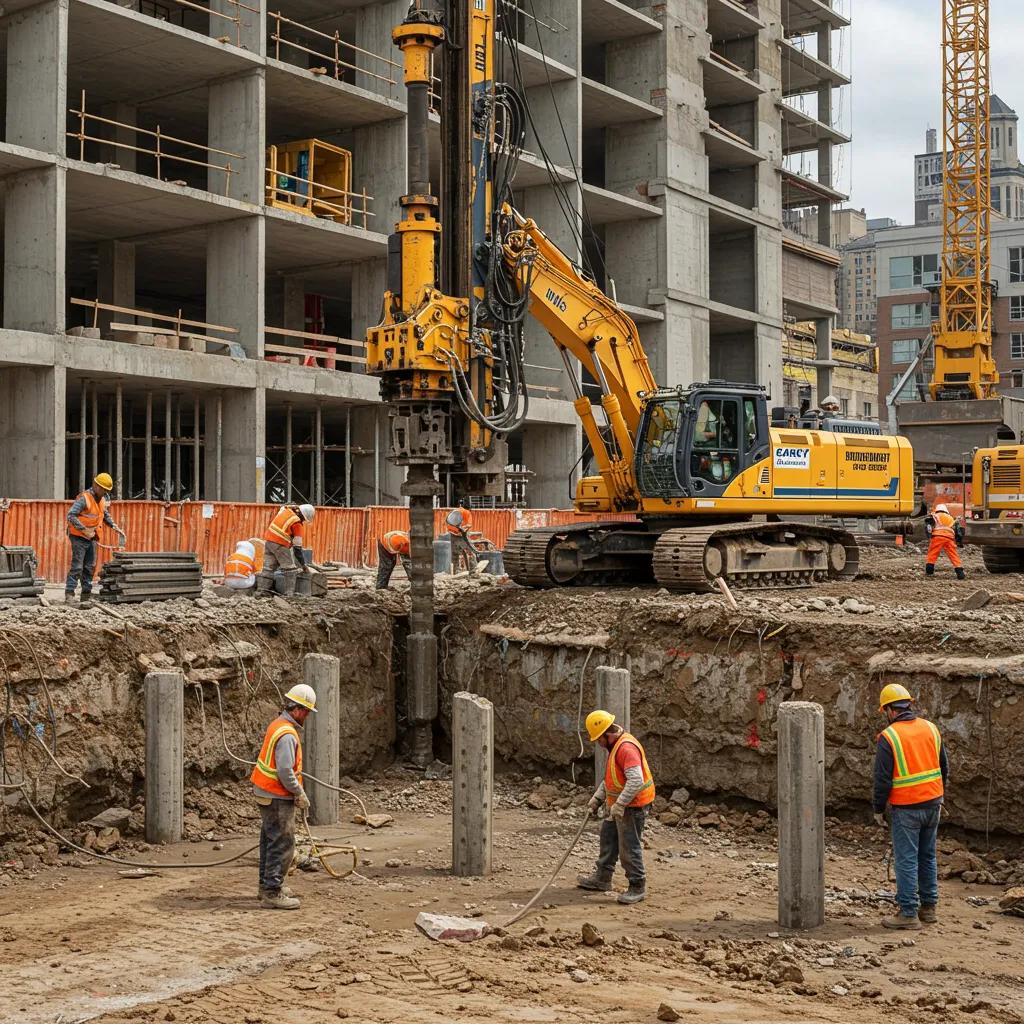
Piling and deep foundations are engineered systems that transfer building loads through weak surface soils down to stronger strata, ensuring structural stability and controlled settlement for a wide range of projects. This article explains how piling and deep foundations work, the main methods used in foundation engineering, and practical decision frameworks for choosing the right approach based on site constraints and loads. Readers will gain clear guidance on bored, driven, mini and continuous flight auger (CFA) piling, plus how reinforced concrete, groundworks and formwork combine to create durable foundation solutions. For local clients in London and Surrey seeking practical delivery, B&R Steel Ltd brings family-run reinforced concrete expertise and groundwork capacity to support piling and basement projects with recognised accreditations and a client-focused approach. The guide that follows covers: why deep foundations are required, the different piling types and their applications, reinforced concrete roles and design, essential groundworks and formwork, how to choose a piling method, common challenges and company case studies. Throughout, target terms like piling and deep foundations, bored piling, CFA piling and reinforced concrete foundations are used in context to help practitioners and decision-makers quickly evaluate options.
What Are Deep Foundations and Why Are They Essential in Construction?
Deep foundations are engineered elements—such as piles, drilled shafts and caissons—designed to transfer structural loads through near-surface weak soils into competent bearing strata, providing stability and limiting differential settlement. They work by either end-bearing at a firm layer or by skin friction along the pile shaft, and the selection yields long-term performance benefits including greater load capacity and resilience against groundwater and adjacent excavation effects. Deep foundations are essential where surface soils cannot support design loads, where adjacent structures require minimal settlement, or where basement and civil engineering works demand reliable lateral resistance. Understanding these factors early in design reduces risk and directs appropriate ground investigation and piling selection.
How Do Deep Foundations Support Heavy Structures?
Deep foundations support heavy structures by transferring loads from the superstructure through the foundation element into strata with sufficient bearing capacity; the two principal mechanisms are end-bearing, where the pile toe rests on a hard layer, and skin friction, where load is resisted by shear along the pile shaft. The mechanism used depends on pile length, diameter and local geology, and designers balance end-bearing contribution and skin friction to meet serviceability and ultimate limit states. For multi-storey buildings, longer piles or larger-diameter bored piles often combine both mechanisms, while bridge abutments may rely on discrete deep shafts for both axial and lateral support. Recognising how load distribution shifts with pile design informs testing strategies such as static load testing and dynamic monitoring during installation, which feed back into safe design decisions.
When Is a Deep Foundation Required?
Deep foundations are required when site conditions or project demands exceed the capabilities of shallow foundations; typical triggers include low soil bearing capacity, high structural loads, high groundwater, or proximity to sensitive existing structures that cannot tolerate settlement. A concise checklist helps practitioners decide whether a deep solution is necessary by evaluating soil stratigraphy, allowable settlement, applied loads and programme or access constraints. When any of these factors indicate risk to structural performance or adjacent property, commissioning geotechnical investigations and early piling design is recommended to avoid costly redesigns. These decision points link directly to the choice of piling method and underpin subsequent groundworks planning.
What Are the Main Types of Deep Foundations?
Deep foundations encompass several forms—pile foundations, drilled shafts/caissons and integrated basement raft-plus-pile systems—each tailored to specific geotechnical and structural requirements. Pile foundations include displacement and replacement piles, with hyponyms such as bored piling, driven piling, mini piling and CFA piling forming a practical toolkit for designers and contractors. Drilled shafts provide large-diameter, high-capacity elements for heavy loads, while basement foundations combine retaining structures and piled supports to enable deep subterranean spaces. Understanding these categories clarifies which methods to explore during concept design and leads naturally to detailed comparison of piling methods.
What Are the Different Types of Piling Foundations and Their Applications?
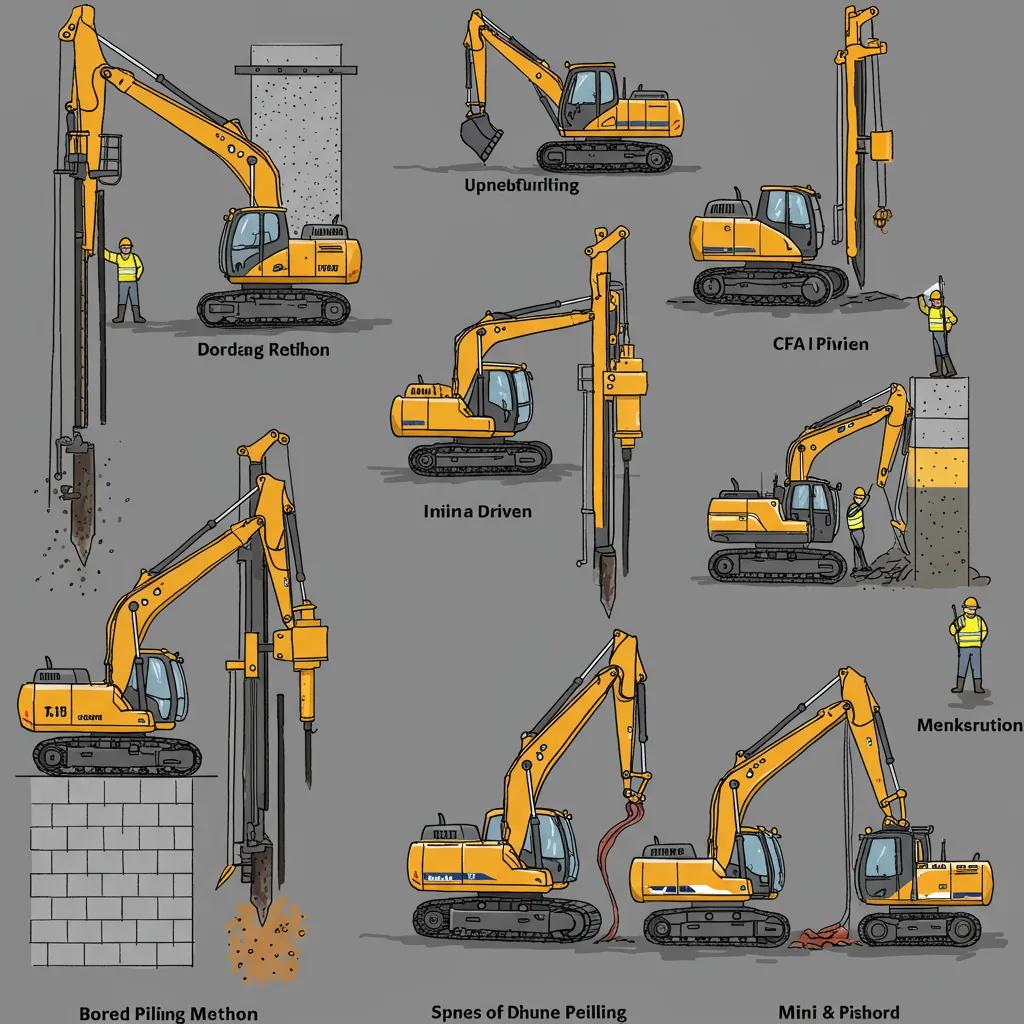
This section defines the primary piling methods, explains how they work, and summarises advantages and constraints to guide method selection; it includes a technical comparison table to help clients and design teams weigh vibration, access and load criteria. The methods profiled include bored, driven, mini and CFA piling, and guidance links these methods to common project types such as urban basements, commercial frames and civil infrastructure. Practical callouts illustrate how contractors apply each method on live projects, with brief examples that show considerations for London and Surrey urban sites.
Different piling methods compared for method selection and site suitability:
| Piling Type | Key Attributes (method, vibration, access requirement) | Typical Uses / Pros / Cons |
|---|---|---|
| Bored piling | Drilled and concreted hole with reinforcement cage; low vibration; needs crane/rig access | Best for high-capacity urban foundations and sensitive sites; pros: low vibration, large diameters; cons: spoil management, deeper temporary works |
| Driven piling | Pre-formed piles hammered or vibrated into ground; high displacement and faster install; vibration/noise issues | Rapid installation and high axial capacity; pros: speed and predictable capacity; cons: noise/vibration near sensitive neighbours |
| Mini piling | Small-diameter bored/displacement piles using compact rigs; low footprint and low disturbance | Ideal for restricted access, underpinning and basement support; pros: minimal access needs; cons: limited capacity per pile, may need many piles |
| CFA piling | Continuous flight auger drilling with concrete pumped during extraction; low spoil and reduced vibration | Good for medium-capacity urban projects with speed and reduced disturbance; pros: continuous operation, less spoil; cons: limited in very stiff strata |
This comparison highlights how each piling type addresses different site constraints and project priorities. Selecting a method involves trade-offs among capacity, disturbance, access and programme, which the next subsections examine in detail.
What Is Bored Piling and When Should It Be Used?
Bored piling involves drilling a cylindrical hole to depth, placing a reinforcement cage and casting concrete in situ, providing large diameters and high axial capacity while producing minimal vibration. It is especially suited to urban basement projects and high-capacity commercial foundations where neighbouring structures require careful settlement control; images of bored rigs illustrate the process and access needs for such jobs. The method handles a wide range of ground conditions and supports large load demands, with the main constraints being spoil handling and temporary works for deep holes. In practice, bored piling is often selected when low vibration and high capacity outweigh the additional site set-up and time compared with driven alternatives.
The complexities of ensuring quality in urban bored piling are significant, involving challenges in pile-bore retention, tip cleaning, and uninterrupted concreting, especially when working in confined and busy city environments.
Quality Control Challenges in Urban Bored Piling
Extensive bored cast-in-situ piling is being undertaken in expanding metropolitan and other major cities for the foundations of multi-storey office and residential buildings, flyovers, and for retaining deep excavations for basements. Roadways are narrow, traffic is heavy, and there are restrictions on the timings for the movement of construction machinery. Amidst these limitations, owners/clients demand rapid construction of piled foundations to enable superstructure erection. Geotechnical consultants and piling contractors encounter significant challenges in urban environments when ensuring the quality of piling operations. These challenges encompass all facets of piling work, including pile-bore retention during boring, pile tip zone cleaning, determining socket lengths in deeply weathered rock strata, meeting pile termination criteria, and uninterrupted concreting. For shoring piles in basement excavations, the installation of anchors presents an additional challenge as they may penetrate adjoining plots. Micropiles are also being extensively employed without due consideration for their inherent limitations in installation and load-carrying capacity. These aspects are discussed in the presented paper.
Challenges to quality control in bored cast-in-situ piling in growing urban environment, 2018
How Does Driven Piling Work and What Are Its Benefits?
Driven piling installs pre-formed piles by hammering or vibrating them into the ground until required resistance is achieved, producing high displacement and predictable performance in many cohesive and granular soils. The method is rapid and offers clear production rates, making it attractive for projects where programme and immediate capacity are priorities; however, noise and vibration management is critical near sensitive properties and traffic. Driven piles perform well for heavy loads and can be tested dynamically during installation to assess capacity, providing designers and contractors with actionable performance data. Where neighbourhood disturbance is acceptable or mitigated, driven piling is an efficient and robust foundation choice.
What Is Mini Piling and Why Is It Ideal for Restricted Access Sites?
Mini piling uses compact drilling rigs and small-diameter piles to deliver piled support where site access is constrained, such as inner-city basements, property underpinning and tight residential plots. Its strength lies in low site footprint, reduced setup time and flexibility to work inside existing structures or where crane access is limited; mini piling integrates well with basement works and ground beams to create continuous support. Capacity per pile is lower, so design uses a matrix of piles with ground beams or pile caps to distribute loads, and installation typically causes minimal vibration. Contractors apply mini piling for lifts, structural alterations and underpinning where larger methods are impractical.
How Does Continuous Flight Auger Piling Compare to Other Methods?
Continuous Flight Auger (CFA) piling uses a hollow auger to drill and then pumps concrete through the auger during extraction, combining speed with reduced spoil and lower vibration than driving operations. CFA is well-suited to medium-capacity foundations in urban sites where limited disturbance and rapid programme are priorities, offering a balance between bored and driven methods in terms of cost and site impact. Its constraints include reduced performance in very stiff or bouldery strata and the need for experienced contractors to manage quality during continuous casting. CFA piles are often chosen for residential and commercial developments where environmental controls and neighbour considerations are significant.
The CFA piling technique offers advantages in soft soil conditions, not only as a soil replacement method but also for its potential to improve surrounding soil properties through pressurized concrete pumping.
CFA Piling for Soft Soil Improvement in Construction
The continuous flight auger (CFA) piling technique is commonly employed where the presence of groundwater or potentially collapsible material diminishes the cost-effectiveness of bored piling methods. Although generally regarded as a soil replacement technique, the process of pumping concrete under pressure during pile installation can lead to significant improvement of the surrounding soil, particularly in low-strength soil conditions. This study analyses a case study. An oil storage tank was intended for construction on soft clay in southern Iraq. The tank has a diameter of 46 m. Cone penetration tests, drilling boreholes, and field tests were conducted at the tank site. A decision was made to enhance the mechanical properties of the site’s soft clay using CFA piles prior to the tank’s construction. The CFA piles constructed have a depth of 16 m, a diameter of 0.5 m, and a spacing of 4.2 m between them. Three types of in-situ tests were performed: Conventional p
Geotechnical Engineering Circular No. 8 Design and Construction of Continuous Flight Auger (CFA) Piles, 2007
How Do You Choose the Right Piling Method for Your Project?
Choosing the right piling method follows a stepwise decision framework centred on site investigation, load requirements and access constraints; a practical checklist helps align project priorities with method attributes. Key steps include commissioning geotechnical surveys, defining allowable settlement and load demands, assessing access and neighbour constraints (noise, vibration), and matching these to piling options and programme constraints. For bespoke advice and method appraisal on London and Surrey projects, consult an experienced piling contractor early in the design phase to integrate piling strategy with groundworks and reinforced concrete design. This decision process minimises redesign risk and optimises cost, schedule and environmental impact.
How Does Reinforced Concrete Enhance Deep Foundation Strength and Durability?
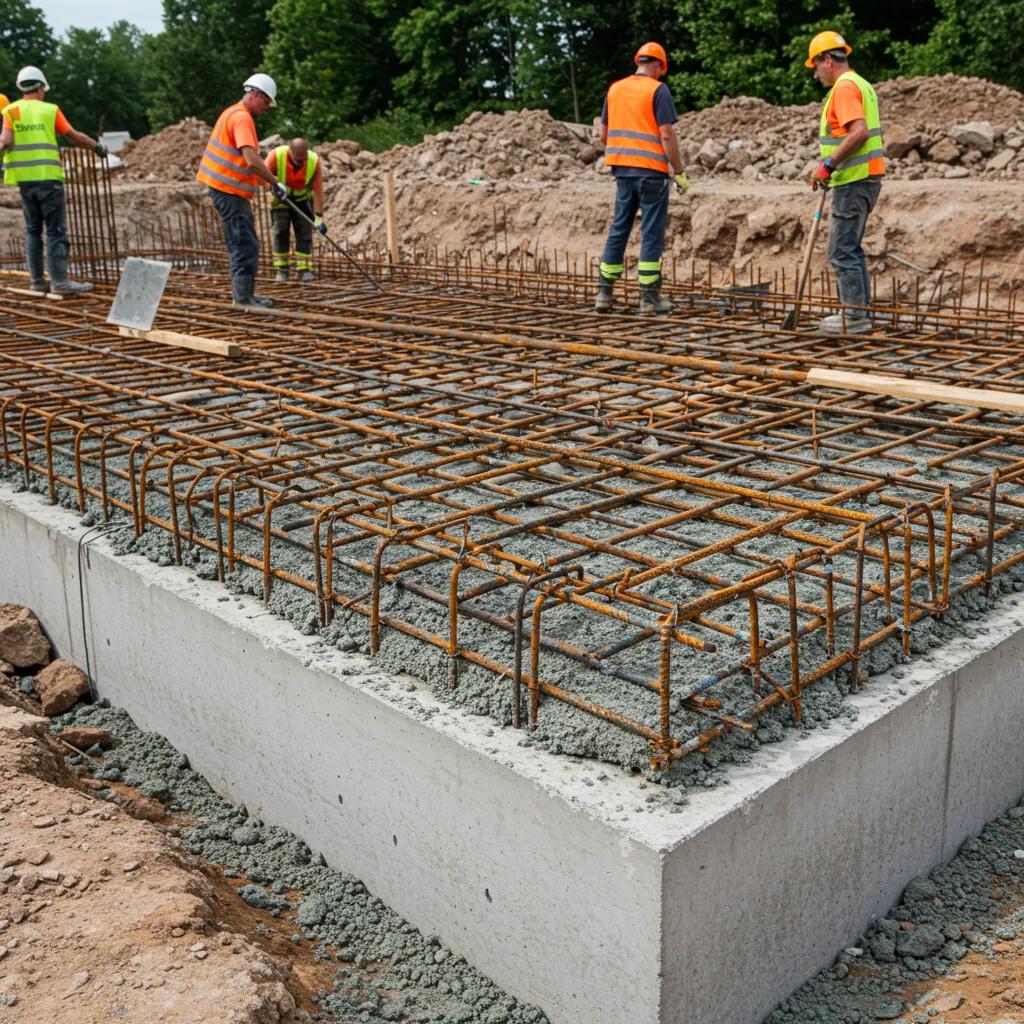
Reinforced concrete combines compressive strength of concrete with tensile capacity of steel reinforcement to produce foundation elements that resist settlement, bending and shearing forces while delivering long service life under varied environmental conditions. The material system benefits foundation performance by enabling pile shafts, pile caps and ground beams to act integrally, controlling deflections and distributing loads evenly into the deep foundation network. Appropriate selection of concrete grade, reinforcement type and cover specification drives durability outcomes and corrosion resistance, and practical on-site handling and curing ensure designed capacity is realised. The table below breaks down key reinforced concrete elements and their performance roles.
Key reinforced concrete components and their performance benefits:
| Element | Attribute | Performance / Benefit |
|---|---|---|
| Reinforcement cage | Steel type, bar diameter, lap/splice design | Provides tensile strength and ductility; controls cracking and shear forces |
| Concrete grade | Characteristic strength (e.g., C32/40), workability | Defines compressive capacity and long-term stiffness; influences durability |
| Cover (concrete cover) | Thickness and quality of placement | Protects reinforcement from corrosion, determining design life in aggressive environments |
| Pile cap / ground beam | Geometry and continuity | Distributes pile loads, resists torsion and connects superstructure to pile network |
What Are the Key Components of Reinforced Concrete Foundations?
The key components include the reinforcement cage, concrete mix and cover, pile caps and ground beams, each contributing to load transfer, crack control and durability. Reinforcement types and placement details control tensile resistance and ductility, while concrete specification determines compressive strength and resistance to environmental attack. Pile caps and ground beams integrate pile groups into continuous structural elements that spread loads across multiple piles and help manage differential movements. Clear coordination between design, reinforcement fabrication and on-site placement ensures the performance targets set by geotechnical and structural engineers are met effectively.
Why Is Reinforced Concrete Crucial for Foundation Longevity?
Reinforced concrete provides long-term stability by combining materials that resist a range of deterioration mechanisms—mechanical loading, chemical attack and freeze/thaw cycles—when designed and detailed appropriately. Durability depends on concrete cover, concrete quality and avoidance of chloride ingress or aggressive exposure conditions; designers specify cover and mix to meet expected exposure classes and service life requirements. Regular inspection, appropriate drainage and maintenance planning reduce the risk of corrosion-related failures and extend service life, which in turn improves lifecycle cost-effectiveness. These durability principles guide material selection and construction practice for sustainable foundations.
How Are Reinforced Concrete Foundations Designed and Installed?
Design of reinforced concrete foundations integrates geotechnical inputs, applied loads and relevant British Standards and Eurocodes to size piles, reinforcement and connecting ground beams; installation follows with quality checks, concrete testing and pile verification. Designers use geotechnical parameters—soil strata, bearing capacity and groundwater—to define pile length, diameter and reinforcement, while contractors implement controlled placement, curing and concrete testing regimes to meet specifications. Installation quality assurance includes pile testing, cover surveys and formwork inspection, each feeding back to the design team where necessary. This structured approach ensures piles and reinforced elements perform as intended under both service and ultimate limit states.
What Are the Essential Groundworks and Formwork Processes for Robust Foundations?
Essential groundworks and formwork processes prepare the site, manage water and provide temporary and permanent support so piling and concrete works execute safely and to specification. These processes include detailed site investigation and enabling works, excavation, drainage and temporary works coordination with piling operations, and selection of formwork systems that suit the project scale and finish requirements. Effective sequencing—investigation, remediation, piling, ground beams, formwork and concrete—reduces risk of rework and integrates waterproofing and retaining-wall work for basements. The following subsections cover site investigation, groundwork services and common formwork options used in foundation projects.
How Is Site Investigation and Preparation Conducted for Deep Foundations?
Site investigation for deep foundations comprises borehole drilling, trial pits, in-situ testing and contamination or groundwater assessment that feed directly into piling specification and foundation design. Geotechnical data provide parameters such as bearing strata depth, shear strength and compressibility that determine pile length, type and testing regimes; results may also identify ground improvement needs such as grouting or stabilisation. Enabling works—temporary fencing, access roads and drainage control—prepare the site and mitigate environmental impact during piling operations. Early investigation allows realistic budgeting and planning, enabling alignment of piling method to actual ground conditions.
What Groundwork Services Support Piling and Deep Foundations?
Groundwork services that support piling include excavation, formation of ground beams and slabs, drainage installation, temporary works and interfacing with piling crews to ensure sequence and safety. These services coordinate with piling to create a contiguous foundation system where pile heads are connected by pile caps and ground beams to support superstructure loads and basement retention. Effective drainage and dewatering protect excavations and concrete pours from groundwater, while temporary works such as propping and road management maintain site safety and public access. A practical list of core groundwork tasks clarifies contractor responsibilities and points of interface for clients and design teams.
Core groundwork services essential for foundation projects:
- Excavation and formation of raft or slab levels to design depths and tolerances.
- Construction of ground beams and pile caps to connect pile network and distribute loads.
- Installation of site drainage, sump systems and temporary dewatering where groundwater is present.
- Provision of temporary works, traffic management and coordination with piling operations.
These services ensure piling and concrete works can proceed reliably, and close coordination minimises programme delays and cost risk while protecting finished structure integrity.
What Types of Formwork Are Used in Foundation Construction?
Formwork systems range from traditional timber shuttering to engineered modular systems designed for speed, finish and reusability, with selection driven by project scale, finish quality and lifecycle cost. Engineered systems provide consistent finishes and rapid turnaround on larger commercial projects, while timber formwork can be economical for bespoke or small-scale elements; both must meet safety and alignment tolerances for pile caps and ground beams. Selection criteria include speed of construction, required surface finish, reusability and site logistics; the right choice reduces labour and improves quality control during concrete placement. Proper formwork inspection and bracing are essential steps before concrete pours to maintain geometry and structural performance.
Why Choose B&R Steel Ltd as Your Expert Piling Contractor in Surrey and London?
B&R Steel Ltd is a family-run concrete contractor providing comprehensive reinforced concrete and piling services across London and Surrey, offering practical delivery capacity for basements, ground beams and reinforced structures. The company positions itself as a lead generation and information hub with experience in reinforced concrete, RC structures and basement works, and operates with accreditations that support quality and safety. Their local knowledge and integrated service offering make them a practical partner for projects requiring close coordination between piling crews and groundworks teams. The following subsections detail credentials, quality controls, sectors served and contact guidance to facilitate client engagement.
What Unique Experience and Accreditations Does B&R Steel Ltd Offer?
B&R Steel Ltd is described in company information as a family-run concrete contractor with family experience in construction stretching back to earlier decades and established company activity since 2008, providing specialties in reinforced concrete and basements. The business profile lists accreditations and competency indicators relevant to clients, including CITB, SafeContractor, CSCS, NVQ and CHAS, which collectively signal workforce competence and commitment to safe delivery. These credentials support design teams and clients by demonstrating recognised standards of training, health and safety management, and quality control that matter on complex piling and basement projects. Clients often prioritise accredited contractors to reduce programme and compliance risk when working in constrained urban sites.
How Does B&R Steel Ltd Ensure Quality, Safety, and Environmental Responsibility?
B&R Steel Ltd emphasises quality and safety through accredited training, on-site supervision and structured quality assurance processes that align with industry expectations for piling and reinforced concrete works. Environmental responsibility is reflected in stated commitments to waste minimisation and the use of recycled materials where appropriate, assisting clients to reduce embodied carbon and site waste. Practical measures such as controlled spoil management, dust and silt controls and coordination with local stakeholders further reduce environmental and neighbour impact during piling operations. These combined actions help clients meet regulatory and sustainability objectives while preserving construction quality.
Which Sectors and Project Types Does B&R Steel Ltd Serve?
B&R Steel Ltd serves residential, commercial, industrial and civil sectors, delivering scalable solutions ranging from underpinning and residential basements to commercial piling and ground beam networks. Typical project types referenced include basements with associated retaining walls and waterproofing, ground beams and reinforced concrete frames that integrate with piled foundations for larger buildings. The company’s local presence in London and Surrey enables familiarity with regional approvals, neighbouring properties and logistics challenges that commonly affect urban piling projects. Case studies in the following section show how these sector applications translate into measurable delivery outcomes.
How Can You Contact B&R Steel Ltd for Piling and Foundation Services?
For enquiries about piling and deep foundation services, clients are encouraged to reference B&R Steel Ltd’s company profile and to request a site survey or quotation through their published contact routes and business profile listings. When preparing to request a quote, provide project basics such as site location, proposed building loads, expected basement depth and any geotechnical data available to accelerate the appraisal process. Early engagement with a contractor aids method selection, value engineering and programme planning, particularly for constrained urban schemes in London and Surrey. A prompt site survey and collaborative briefing stage helps align piling strategy with construction sequencing and client priorities.
What Are Common Foundation Challenges and How Do Piling Solutions Address Them?
Foundations face challenges including weak or variable soils, restricted urban access and environmental or regulatory constraints; piling solutions and associated groundworks tackle these issues through specific engineering measures. Piling allows load transfer past poor strata, ground improvement techniques reduce compressibility and specialised piling methods mitigate disturbance in sensitive neighbourhoods. Addressing these challenges requires an integrated approach combining geotechnical data, method selection, temporary works and environmental controls. The next subsections provide practical problem-solution approaches for typical foundation risks encountered on urban projects.
How Is Weak or Unstable Soil Managed with Deep Foundations?
Weak or unstable soils are managed by transferring loads to competent layers using end-bearing piles or by mobilising skin friction via longer shafts, and by complementing piles with ground improvement techniques such as grouting or soil replacement where appropriate. Designers evaluate whether deep foundations or ground improvement provide a more cost-effective solution by considering long-term settlement, programme and adjacent structure sensitivity. Testing—trial pits, boreholes and plate tests—verifies the approach and supports pile testing regimes to validate design assumptions on site. This combination of investigation, method selection and verification reduces the risk of post-construction settlements that can affect performance.
What Are Solutions for Restricted Access and Urban Site Constraints?
Restricted access and tight urban sites are routinely addressed using mini piling, CFA and other low-impact piling methods that require compact rigs and generate lower vibration and spoil volumes. Practical measures include staged excavation, traffic and pedestrian management, and night-shift coordination where permitted to maintain programme while limiting disruption. Site logistics planning and pre-construction surveys help define safe plant movements and neighbour liaison strategies, ensuring piling operations proceed without undue impact. These approaches allow deep foundations to be delivered even in congested city locations where conventional large rigs cannot operate.
How Do Piling Methods Adapt to Environmental and Regulatory Requirements?
Piling methods adapt to environmental and regulatory requirements through noise and vibration controls, silt and runoff management, permitting and monitoring systems that ensure compliance with local authorities and planning conditions. Operators implement mitigation measures such as working hour restrictions, acoustic screens, vibration monitoring and silt traps to protect adjacent properties and watercourses. Compliance also includes reporting to clients and authorities, maintaining records of testing and inspections, and following best practice from industry bodies to reduce environmental impact. Such adherence not only meets statutory obligations but also supports project timelines and stakeholder relationships.
What Are Recent Case Studies Demonstrating B&R Steel Ltd’s Piling and Deep Foundation Expertise?
Presented here as structured project summaries, these case studies illustrate how piling methods, reinforced concrete works and sustainable practices combine to deliver measurable outcomes in Surrey and London projects; they are designed to help prospective clients assess capability and request similar services. Each project entry sets out the challenge, the technical solution (piling method and reinforced concrete works), and the outcome in terms of timescale, capacity and client benefit. The table below summarises representative projects to provide a concise evidence base for client decision-making.
Representative project case studies:
| Project | Challenge | Solution (piling method + RC works) | Outcome (timescale, load, client benefit) |
|---|---|---|---|
| Surrey commercial frame | Poor near-surface soils and tight programme | Bored piles with reinforced pile caps and ground beams | Timely delivery, high axial capacity, reduced settlement risk |
| London residential basement | Restricted access, need for underpinning | Mini piling with ground beams and retaining wall integration | Minimal neighbour disruption, waterproofed basement formed |
| Urban retrofit project | Waste reduction and material reuse desired | CFA piling and recycled concrete use in ground beam pours | Lower site spoil, reduced waste, efficient installation |
How Were Complex Commercial Piling Projects Successfully Completed in Surrey?
Commercial projects in Surrey often combined bored piling with detailed QA and reinforced concrete pile caps and ground beams to meet high loadings and programme requirements. Project teams coordinated geotechnical input, temporary works and reinforcement fabrication to maintain progress while protecting adjacent assets, and static testing confirmed pile performance before superstructure works began. Delivering to schedule and specification produced tangible client benefits: predictable settlement control, compliant structural performance and reduced post-construction risk. Such integrated delivery models underscore the importance of early contractor involvement for complex commercial piling jobs.
What Solutions Were Implemented for Residential Basement Foundations in London?
For London basement projects the approach frequently combined mini piling, underpinning and integrated ground beams with waterproofing and retaining-wall detailing to create habitable subterranean spaces with minimal external disruption. Compact rigs enabled operations within confined gardens or narrow streets, while careful sequencing of excavation, temporary supports and waterproofing ensured structural integrity and client peace of mind. The result was successful basement formation with controlled settlement and neighbour-friendly installation, demonstrating how piling and RC works adapt to dense urban contexts. Clients benefit from tailored piling strategies aligned with local constraints and regulations.
How Has B&R Steel Ltd Incorporated Sustainable Practices in Recent Projects?
Sustainable practices implemented on recent projects include waste minimisation, selective reuse of inert materials and adoption of lower-waste piling methods where appropriate to reduce embodied impacts and site spoil. The company’s operational focus on efficiencies—such as optimising pile designs to reduce concrete volumes and employing methods that minimise spoil—delivers practical environmental benefits without compromising structural performance. These measures support client sustainability objectives by lowering site waste and contributing to more efficient material use in foundations. Clients often find that modest changes in method and specification can yield tangible sustainability gains.
What Are Frequently Asked Questions About Piling and Deep Foundations?
This FAQ section provides concise, actionable answers to common questions clients raise when evaluating piled foundations, supporting featured-snippet style responses and guiding early-stage decision-making. Each Q&A is crafted to be clear and directly useful to project stakeholders, with guidance on when to seek geotechnical input and how to evaluate contractors. Short answers facilitate quick reference while pointing to the detailed sections above for deeper technical insight.
What Are the Main Types of Deep Foundations?
The main types of deep foundations are piles (bored, driven, CFA and mini), drilled shafts/caissons and integrated basement piling systems, each serving different load, access and soil conditions. Piles transfer loads by end-bearing or skin friction, drilled shafts provide large-diameter high-capacity elements, and basements often combine retaining walls with piled supports. Choosing among these depends on geotechnical data, structural loads and site logistics. For most urban projects, a combination of methods may be used to balance capacity, disturbance and programme requirements.
When Is Piling Necessary for Construction Projects?
Piling is necessary when surface soils lack sufficient bearing capacity, when imposed loads are very high, when groundwater or contamination complicate shallow foundations, or when proximity to existing structures requires settlement control. If any of these conditions apply, commission a geotechnical investigation early to determine whether piling or ground improvement is the most cost-effective solution. Early contractor engagement helps align piling strategy with design and programme. This pre-emptive approach reduces design revisions and potential delays.
What Are the Benefits of Reinforced Concrete Foundations?
Reinforced concrete foundations combine strength, durability and fire and water resistance to provide long-lasting structural support with relatively low maintenance when designed correctly. Benefits include reliable load distribution, control of settlement and cracking, and adaptability to complex foundation geometries such as pile caps and ground beams. Appropriate material selection and detailing enhance corrosion resistance and service life, contributing to lower whole-life costs. These attributes make reinforced concrete the predominant choice for piled foundations in many sectors.
How Do I Choose a Reliable Piling Contractor in Surrey or London?
Select a piling contractor by checking experience with similar project types, relevant accreditations, local knowledge, available case studies and clarity of communication during pre-construction stages. Request references, evidence of accreditations such as CITB or SafeContractor, and examples of recent projects in London or Surrey to verify capability and approach. Ensure the contractor provides a clear site survey proposal and a method statement addressing noise, vibration and environmental controls. Early engagement and a transparent tender process reduce risk and support informed method selection.