
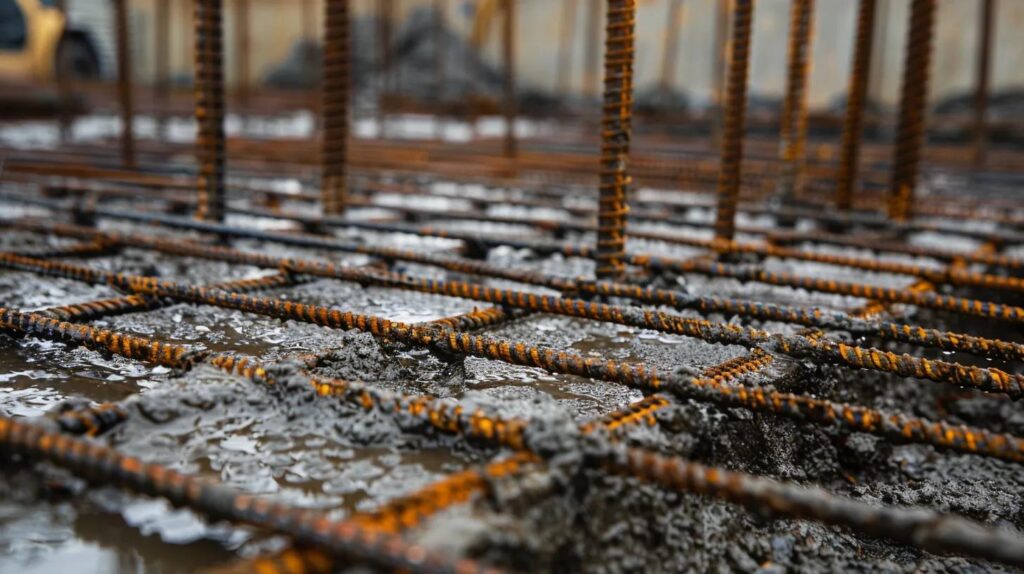
Reinforcing Steel and Mesh: Essential Strength Solutions for Concrete Structures in Surrey and London
Reinforcing steel and reinforcing mesh are the primary means of giving concrete the tensile strength and ductility it lacks, creating durable structural concrete solutions for buildings and infrastructure in Surrey and London.
This article explains what reinforcing steel (rebar) and welded wire mesh are, how they interact with concrete, and the practical benefits for slabs, RC frames and basements.
Many designers and contractors need clear guidance on selecting steel grades, mesh sizes and installation best practice to avoid cracking, corrosion and premature maintenance; this guide delivers engineering rationale, specification tips and on-site procedures that reduce risk.
You will find technical comparisons, EAV-style tables of typical grades and diameters, step-by-step installation checklists, formwork and groundworks considerations, plus sustainability trends affecting reinforcement choices in 2025.
The sections that follow cover: what reinforcing steel and mesh are and the standards that govern them; how reinforced concrete benefits residential and commercial projects locally; best practices for fabrication and installation; formwork systems; essential groundworks; sustainable reinforcement options; and a compact FAQ and contact guidance for quotes and surveys.
What Is Reinforcing Steel and Mesh and Why Are They Vital for Concrete Structures?
Reinforcing steel and welded wire mesh are steel products placed within concrete to resist tensile stresses and control crack widths, acting as the structural backbone where concrete excels in compression but is weak in tension.
The mechanism is composite action: steel takes tensile load while concrete carries compressive forces, which improves serviceability and extends design life. Typical benefits include improved load-bearing capacity, crack control and ductility under dynamic or seismic loads; these benefits translate into lower lifecycle repair costs and enhanced occupant safety.
Understanding the differences between rebar and mesh helps specify the right product for slabs, beams, walls and basements and ensures compliance with standards such as BS 4449 and recognised welded mesh specifications.
Rebar versus welded mesh comparison table
| Reinforcement Type | Characteristic | Typical Application |
|---|---|---|
| Rebar (BS 4449) | High-yield steel bars with specified diameters and yield strengths | Beams, columns, RC frames, piled raft connections |
| Welded wire mesh (A193-type styles) | Grid of welded wires in rolls or sheets for uniform slab reinforcement | Domestic ground slabs, screeds, pavements, thin slabs |
| Epoxy-coated / stainless options | Enhanced corrosion resistance for aggressive environments | Basements, marine-adjacent structures, chemical exposure |
This comparison shows how designers select rebar for bespoke structural elements and mesh for uniform slab reinforcement, guiding specification choices on project drawings and schedules.
What Are the Key Types of Reinforcing Steel Used in Construction?
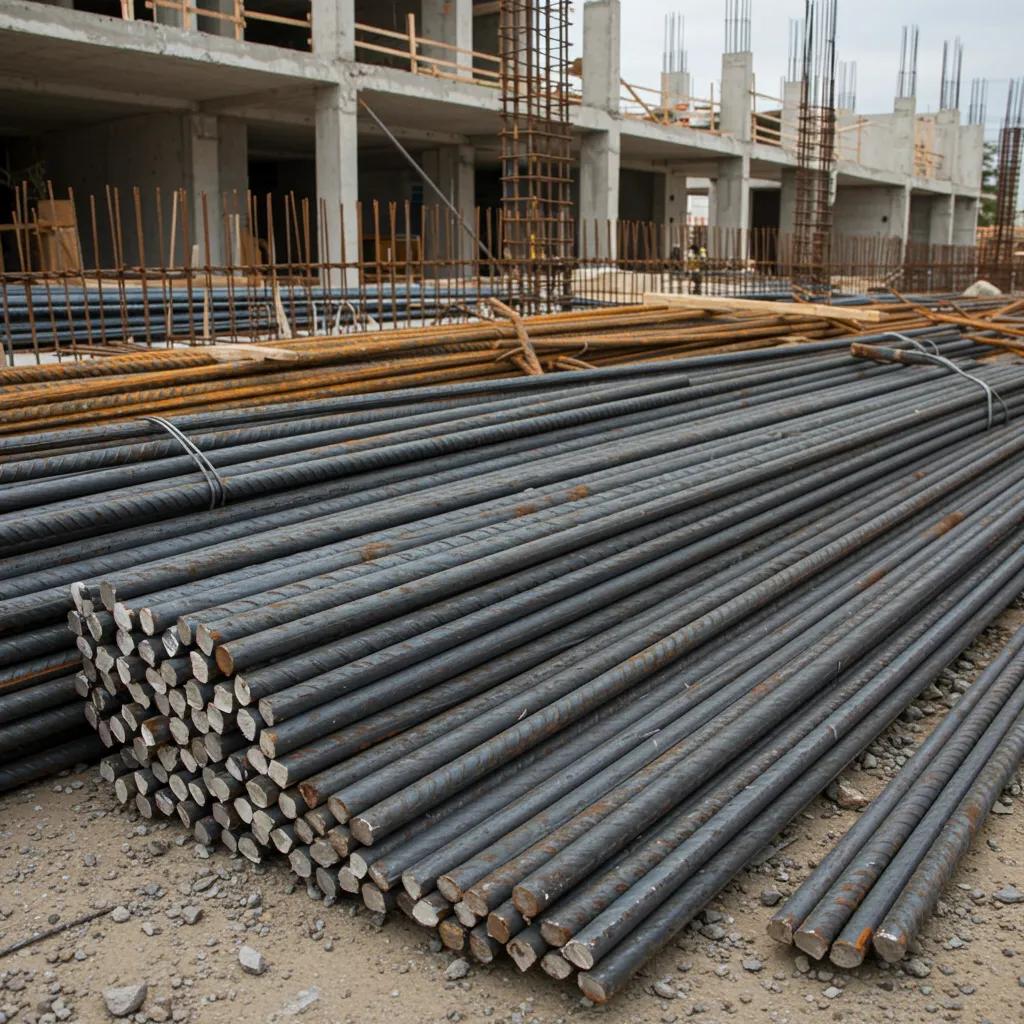
Key types of reinforcing steel used in UK practice include high-yield deformed bars commonly specified to BS 4449, plain round bars for minor uses, and coated or stainless options where corrosion risk is elevated. Designers choose bar diameters to match bending schedules and load paths; typical sizes range from small-diameter starter bars to larger 20–40 mm bars for primary members.
Corrosion protection options such as epoxy coating or specifying stainless grades are selected when cover cannot be guaranteed or when structures face aggressive exposure. Practical selection is governed by structural engineer schedules and project-specific exposure classes, and checking the relevant standard ensures material performance aligns with design intent.
How Does Reinforcing Mesh Differ from Rebar in Concrete Applications?
Welded reinforcing mesh is supplied in sheets or rolls and provides a regular grid that controls cracking across slabs and thin structural elements, while rebar is used where bespoke reinforcement layout, bending or anchorage is required. Mesh is fast to place for large-area slabs and reduces labour for uniform reinforcement, whereas rebar supports concentrated load paths in beams, columns and deep rafts.
Lap splice lengths, cover and chairing requirements differ between mesh and rebar; mesh typically requires correct chairs and minimum cover but less on-site bending. Choosing between mesh and rebar depends on structural function, slab thickness and the need for shaped reinforcement around openings or penetrations.
Research into the mechanical behaviour and testing of welded wire steel mesh highlights its critical role in various applications, emphasizing the impact of testing configurations on performance quantification.
Welded Wire Mesh: Mechanical Behaviour and Testing
This paper reviews the mechanical behaviour of welded wire steel mesh routinely used in underground mines. It further reviews the advantages and limitations of using testing rigs employed to quantify mesh performance. In particular, it illustrates the impact of rig configuration and testing parameters on mesh performance.
Understanding the impact of test configuration on welded-wire mesh laboratory test results, E Karampinos, 2020
Why Is Steel Reinforcement Critical for Structural Integrity in Concrete?
Steel reinforcement provides ductility and tensile capacity that concrete lacks, enabling structures to redistribute loads and sustain deformations without sudden failure, which is essential for safety and long-term performance. By limiting crack widths and sharing tensile forces, reinforcement preserves durability and reduces the risk of corrosion initiation in the concrete cover.
This composite behaviour increases tolerance to overloads and dynamic actions such as traffic or wind, and it helps maintain serviceability criteria set by engineers. Proper detailing and placement of reinforcement directly influence how well structures perform under real loads and environmental exposure.
What Standards and Grades Govern Reinforcing Steel and Mesh?
British and European standards define material requirements, mechanical properties and testing protocols for reinforcing steel and welded mesh, with BS 4449 commonly used for rebar specification and recognised mesh designations for welded wire fabric. Specifiers should reference yield strength, elongation and product traceability in contractual documents and check that supplied material certificates match the project schedule.
Standard-compliant reinforcement helps ensure predictable behaviour, correct bending and welding allowances, and appropriate acceptance criteria during inspections. For every project, the structural engineer’s specification should be the primary reference, with procurement verifying certificates and batch documentation before fabrication.
How Do Reinforced Concrete Solutions Enhance Residential and Commercial Projects in Surrey and London?
Reinforced concrete solutions such as RC frames, reinforced slabs and basements deliver structural robustness and design versatility for both residential and commercial developments across Surrey and London, adapting to diverse ground conditions and tight urban constraints.
Reinforced concrete allows efficient load transfer, long spans, and integration of services, while providing excellent fire resistance and acoustic mass for buildings. Local projects particularly benefit from tailored solutions for basements and party-wall conditions, where reinforcement detailing and waterproofing must be coordinated closely.
Developers and main contractors gain schedule certainty and reduced long-term maintenance when reinforcement is correctly specified and installed to industry standards.
Practical benefits list
- Load-bearing efficiency: RC frames support multi-storey loads with predictable deflection and stability.
- Durability and fire resistance: Mass concrete with proper cover resists fire and long-term degradation.
- Versatility: Reinforcement layouts cater for large openings and bespoke architectural forms.
These benefits make reinforced concrete a preferred choice in urban projects, and the next section explains how the composite action of steel and concrete achieves those advantages.
What Is Reinforced Concrete and How Does It Work with Steel Reinforcement?
Reinforced concrete is a composite material in which steel reinforcement is embedded to resist tensile stresses and control cracking, enabling structures to meet load and serviceability requirements. Concrete provides compressive strength while steel supplies tensile resistance; together they form a system that follows load paths defined by structural design.
Correct placement of reinforcement relative to expected stress trajectories, together with sufficient concrete cover, ensures durability and serviceability. Detailing must reflect load reversals, shrinkage and thermal movements so that the reinforcement layout prevents undesirable crack patterns and maintains structural capacity.
How Are RC Frames Designed and Constructed for Maximum Strength?
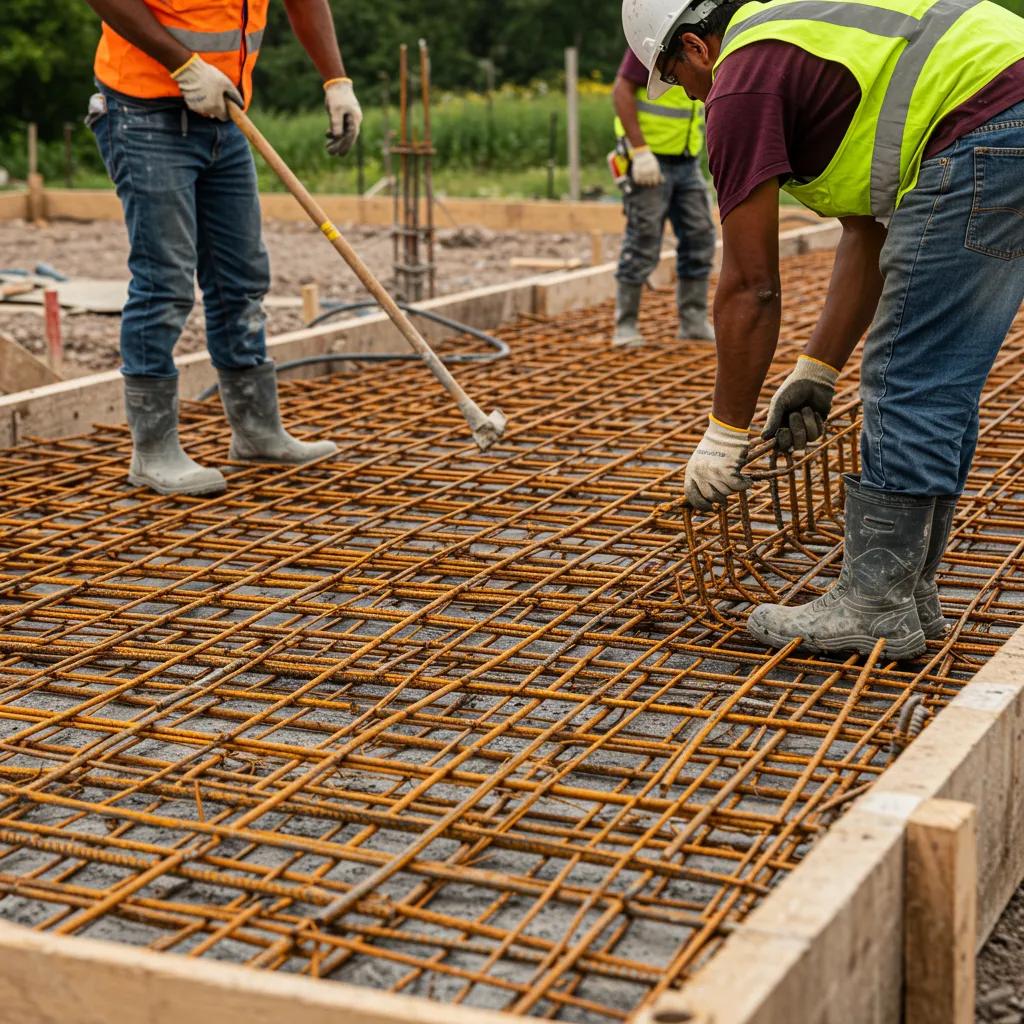
RC frames are designed as interconnected beams, columns and slabs where reinforcement is detailed to transfer bending and shear forces through adequate bar sizes, anchorage and splicing; construction sequencing aligns fabrication, fixing and formwork to ensure structural integrity.
Successful RC frame construction follows a clear sequence: design and detailing, prefabrication of cages where appropriate, accurate on-site fixing, inspection and finally concreting with controlled curing. Quality checkpoints at each stage reduce rework and guarantee that cover, lap lengths and bar positions meet the structural drawings. Coordination with formwork and concrete suppliers is essential to maintain pour schedules and minimise defects.
What Role Does Reinforcing Mesh Play in Concrete Slabs and Foundations?
Reinforcing mesh provides distributed crack control across slabs and foundations by delivering a regular grid that limits crack widths and improves surface load distribution, making it efficient for domestic ground slabs and industrial floor areas.
Mesh selection is driven by slab thickness, expected loads and exposure; heavier gauge mesh or closer wire spacing is chosen for high-load or industrial uses. Correct installation uses chairs or spacers to maintain design cover and required laps at joints, with attention to openings where additional reinforcement is needed. For large slabs, mesh reduces labour and ensures uniform performance when specified and placed correctly.
How Do Reinforced Concrete Basements Benefit from Steel Reinforcement?
Reinforced concrete basements rely on well-detailed wall and raft reinforcement to resist earth pressures, hydrostatic loads and imposed internal loads while integrating waterproofing systems to prevent ingress. Reinforcement in basement walls and rafts must account for tiebacks, movement joints and service penetrations; proper detailing prevents stress concentrations and seal failure at interfaces.
Coordination between waterproofing installers and reinforcement fixers ensures that membranes, drainage and concrete cover are compatible, reducing leak risk and maintenance. Professional detailing and installation of reinforcement in basements provide a stable structural envelope and help maintain long-term watertight performance.
After explaining applications and benefits above, B and R Steel Ltd can advise on the correct steel grades and mesh sizes for UK projects and supply reinforcing mesh and steel reinforcement services tailored to site conditions and engineer specifications. As a family-run contractor serving London, Surrey and the South of England, the company supports clients with specification advice and supply options for slabs, RC frames and basement projects.
What Are the Best Practices for Steel Reinforcement Installation and Fabrication?
Best practices for fabrication and installation combine accurate off-site prefabrication where beneficial, disciplined on-site fixing, and thorough inspection to verify cover, lap lengths and bar positions before placing concrete. Fabrication in controlled environments improves dimensional accuracy for cages and reduces site labour, while on-site checks ensure that tolerances and chairing are correct to meet structural drawings.
Inspection protocols at fixing stage should include material traceability, placement checks and photographic records; these checkpoints prevent errors that would otherwise be costly to rectify after pouring. Implementing these procedures reduces defects, increases predictability and enhances both structural performance and client confidence.
Fabrication & installation quality checks table
| Fabricated Element | QC Attribute | Acceptance Criteria |
|---|---|---|
| Rebar cages | Dimensional accuracy | Within drawing tolerances; bending and hook checks |
| Mesh sheets/rolls | Lap and alignment | Correct lap length and continuous grid alignment |
| Chairs and spacers | Position and capacity | Maintain design cover under load with no displacement |
This QC table helps teams focus inspections on the attributes that most directly affect durability and structural performance, reducing risk at pour time.
How Does B and R Steel Ltd Ensure Quality in Rebar Fabrication and Mesh Supply?
B and R Steel Ltd applies a structured fabrication and supply workflow rooted in practical experience and industry accreditations, providing traceable material certificates and prefabricated elements where the programme benefits from reduced site labour. The company’s family-run background supports close client communication, and safety credentials noted in reporting — including recognised accreditations — are used as operational trust signals on projects.
Fabrication combines off-site bending and cage assembly with documented checks for bar lengths, bends and tie patterns; supply logistics are managed to align deliveries with groundworks and formwork sequences. For specification queries and material schedules, B and R Steel Ltd offers direct advice and site survey options to confirm appropriate grades and mesh sizes.
What Safety and Environmental Standards Guide Steel Reinforcement Work?
Safety and environmental practice on reinforcement projects includes worker competence verification, safe lifting and handling procedures, and waste minimisation strategies to reduce scrap and offcuts. Accredited safety schemes and worker qualifications provide frameworks for safe operation and compliance, while site measures such as segregation of waste, recycling of steel offcuts and minimised packaging reduce embodied impacts.
Environmental management also encourages specifying recycled-content steel where appropriate and coordinating cuts to reduce scrap. Adhering to these practices ensures safe installations and advances sustainable construction objectives on site.
How Is Reinforcing Steel Installed to Prevent Concrete Cracking and Structural Failures?
Preventing cracking and failures depends on providing correct cover, ensuring adequate lap and anchorage lengths, using appropriate chairs and spacers, and incorporating control joints and curing regimes that mitigate shrinkage and thermal movement. Installation checklists should include cover checks at multiple points, lap verification against the structural schedule, and correct bending/hook implementation to meet design anchorage.
Proper curing after pouring reduces early-age cracking and helps reinforcement remain protected within the concrete matrix. Applying these measures as standard practice reduces defect rates and enhances the long-term durability of reinforced concrete elements.
What Are the Common Challenges in Steel Fixing and How Are They Overcome?
Common challenges in steel fixing include site congestion that restricts access, dimensional tolerances that lead to clashes, and sequencing conflicts with formwork and service trades; these are overcome through prefabrication, mock-ups and tighter coordination.
Prefabricated cages reduce on-site labour and improve fit, while early co-ordination meetings and BIM or setting-out checks reduce dimensional clashes. Increased inspection frequency during complex sequences and contingency plans for access or temporary works mitigate delays. These mitigation strategies improve productivity, reduce rework and ensure reinforcement performs as designed in congested urban projects.
How Do Formwork Systems Support Reinforced Concrete Construction?
Formwork systems provide the temporary moulds that shape concrete and hold reinforcement in position, and choosing the correct system influences finish quality, accuracy of cover and overall programme efficiency. Engineered system formwork delivers repeatable accuracy for multiple identical elements, while timber-based or bespoke formwork supports irregular or architectural shapes.
Formwork design must consider loads, propping and interaction with reinforcement to ensure that imposed forces do not displace bars or chairs during pouring. Selecting the appropriate formwork balances cost, labour and turnaround time to meet project-specific constraints.
Formwork comparison table
| Formwork Type | Best-use Application | Cost / Time Consideration |
|---|---|---|
| Engineered system formwork | Repetitive vertical elements, slabs with props | Higher hire cost but faster reuse and predictable finish |
| Timber formwork | Bespoke shapes and one-off elements | Lower material cost but more labour and longer assembly |
| Stay-in-place formwork | Insulated or composite systems | Saves removal time; higher material cost but quicker programme |
This table clarifies how system choices affect programme and finish, guiding decisions for urban projects where access and repetition matter.
What Are the Different Types of Concrete Formwork Used in Surrey and London?
In Surrey and London projects, engineered system formwork is common for repetitive vertical cores and multi-storey frames, while timber formwork remains in use for bespoke or architecturally complex elements. System formwork reduces labour on repetitive tasks and is suited to hire models for contractors seeking turnaround efficiency, while timber allows tailored shaping where off-standard finishes are required.
Stay-in-place and insulated formwork solutions are selected where thermal performance or rapid programme acceleration is required. Choice depends on site access, repetition, finish quality and contractor capabilities.
How Is Formwork Designed for Basements, Bridges, and Staircases?
Formwork design for basements emphasises robust anchorage to resist lateral earth pressures during backfill sequences, while bridge decks require long-span propping and careful camber control; staircases need precise soffit formwork to achieve consistent riser and tread dimensions. Each element brings specific propping loads, formwork tie requirements and sequencing constraints that affect reinforcement placement.
Designers must model propping loads and interaction with reinforcement cages to ensure structural geometry is maintained through pour and curing. Detailed coordination reduces remedial works and achieves intended finishes.
Why Is Proper Formwork Essential for Steel Reinforcement and Concrete Strength?
Accurate formwork ensures that specified cover and reinforcement positions are maintained during pouring, which directly affects durability and structural capacity by preventing unintended loss of cover or misalignment. Misaligned formwork can lead to inadequate cover, exposing steel to accelerated corrosion or failing to achieve the design load paths.
Inspection of formwork before placing reinforcement and again before pouring is essential to confirm alignment and tie positions. Correct formwork practice supports quality concrete finishes and protects the embedded steel that gives the structure its tensile capacity.
What Are Cost-Effective Formwork Solutions for Large Construction Projects?
Cost-effective strategies for large projects include hiring engineered system formwork for repetitive elements, optimising turnaround through planned logistics, and integrating prefabricated reinforcement to reduce on-site labour. Balancing hire versus purchase depends on project duration and repetition; system hire often offers the best value for RC frames with repeated bays.
Life-cycle cost considerations favour systems that reduce labour and improve cycle times, and close coordination with reinforcement prefabrication amplifies savings. These optimisations improve programme certainty and reduce overall project risk.
What Groundworks and Foundation Services Are Essential for Reinforced Concrete Structures?
Proper groundworks prepare the site so reinforcement and concrete can perform as designed; this includes thorough site investigation, accurate setting out, formation of sub-bases, blinding and temporary works to support reinforcement installation and pouring.
Foundation choice—shallow footings, ground beams, rafts or piled solutions—depends on soil conditions and loadings, and reinforcement detailing must reflect that selection. Waterproofing and drainage integration are critical for basements to protect reinforcement and the structure, with coordination required between groundworks, reinforcement fixing and membrane installers.
Professional groundworks reduce the risk of settlement, provide schedule predictability and support long-term structural performance.
Essential groundworks steps list
- Site survey and investigation: determine soil strata and groundwater conditions.
- Excavation and formation: prepare sub-base, compact, and install blinding where required.
- Setting out and temporary works: accurate levels and access for reinforcement installation.
These steps create the conditions necessary for correct reinforcement placement and reliable concrete performance, which leads into foundation-specific roles discussed below.
How Do Groundworks Prepare Sites for Steel Reinforcement and Concrete Pouring?
Groundworks set out accurate levels, compact sub-bases and provide blinding concrete or compacted granular fill to stabilise the formation and support chairs and reinforcement during placement. Setting out must reflect the structural grid and ensure that reinforcement cages are dropped into position without distortion, while temporary access allows fixing teams to work safely and efficiently.
Blinding provides a clean working surface, protecting reinforcement from contamination and ensuring correct cover is achieved. Good groundworks practice reduces the potential for on-site adjustments that can compromise reinforcement detailing.
What Is the Role of Piling and Ground Beams in Foundation Stability?
Piling transfers loads to competent strata where shallow foundations are unsuitable, while ground beams connect pile caps or pads to distribute loads and provide a working platform for the superstructure’s reinforcement. Designers select piling where poor near-surface soils or high loads demand deeper support; ground beams then integrate with reinforcement cages to transfer bending moments and shear.
Coordination between piling contractors and reinforcement detailers ensures correct embedment lengths and connection details. Proper integration prevents differential settlement and maintains the integrity of the reinforced concrete frame.
How Are Waterproofing and Drainage Integrated into Basement Groundworks?
Effective basement waterproofing is coordinated with reinforcement detailing so that membranes, tanking systems or cavity drainage solutions do not interfere with required cover or lap lengths, and service penetrations are sealed where reinforcement passes through. Sequencing matters: in many cases reinforcement fixing precedes final waterproofing tie-ins to ensure continuity of both structural and watertight systems.
Drainage design and subsoil management reduce hydrostatic pressures on basement walls, lessening demands on reinforcement and structural sections. Close collaboration between waterproofing specialists and reinforcement teams prevents costly interface failures.
What Are the Benefits of Professional Groundworks for Commercial and Residential Projects?
Professional groundworks reduce defects, improve schedule certainty and ensure regulatory compliance, delivering foundations and site conditions that support the intended reinforced concrete performance over the structure’s lifetime. Experienced teams manage risks such as contamination, unexpected ground conditions and access constraints, avoiding delays that can cascade through reinforcement and concrete trades.
Professional delivery improves safety and coordination, ensuring reinforcement can be fixed and poured without compromise. The result is lower long-term maintenance costs and a more predictable handover for clients and stakeholders.
How Does Sustainable Construction Influence Reinforcing Steel and Concrete Practices?
Sustainable construction trends are influencing reinforcement choices by encouraging recycled-content steel, optimised reinforcement layouts to reduce material use and coordination with low-carbon concrete mixes to lower embodied carbon. Steel is highly recyclable, and specifying recycled or lower-embodied alternatives where appropriate can reduce a project’s carbon footprint without compromising structural performance.
On-site waste minimisation and prefabrication of reinforcement reduce cut-offs and transport emissions, while design optimisation reduces overall material volumes. Clients increasingly seek measurable sustainability outcomes, prompting contractors and designers to consider reinforcement choices as part of broader carbon reduction strategies.
What Sustainable Materials and Methods Does B and R Steel Ltd Use in Reinforcement?
B and R Steel Ltd applies waste minimisation and recycling practices in its reinforcement workflow and works to supply materials with appropriate recycled content where project specifications permit, aligning operations with sustainable construction objectives. The company’s approach includes optimising cut lists to reduce offcuts, segregating steel scrap for recycling and coordinating deliveries to reduce transport movements.
These practical measures help clients manage embodied carbon and waste on site, while maintaining the performance and quality demanded in reinforced concrete structures. Clients benefit from practical, measurable steps that reduce environmental impact on local projects.
How Does Steel Reinforcement Contribute to Environmentally Responsible Building?
Steel reinforcement contributes to responsible building through durability—which reduces replacement cycles—and high recyclability at end of life, allowing recovered steel to re-enter production streams and reduce embodied carbon. Durable reinforced concrete structures require less maintenance and replacement, which lowers lifecycle emissions and resource use.
Specifying longer-lasting reinforcement details and protecting steel with adequate cover and coatings in aggressive exposures therefore supports sustainability goals. Designers should balance initial embodied carbon with service life and maintenance implications to achieve the best environmental outcomes.
What Are the Industry Trends in Green Concrete and Reinforcement for 2025 and Beyond?
Industry trends point to greater adoption of low-carbon concrete mixes, increased use of recycled-content steel and tighter regulatory drivers for embodied carbon reporting; practitioners are responding with material optimisation and more integrated design-for-manufacture approaches. Emerging specification guidance and client demand are prompting contractors to offer quantified carbon reductions and lifecycle assessments.
Designers and contractors preparing for these trends should prioritise coordination between reinforcement detailing and mix selection to maximise carbon benefits without sacrificing structural performance. Early-stage collaboration enables pragmatic adoption of green materials within programme and budget constraints.
How Can Clients Benefit from Sustainable Reinforced Concrete Solutions?
Clients gain lower lifecycle costs, improved ESG credentials and potential compliance advantages by opting for sustainable reinforcement and concrete strategies that reduce embodied carbon and waste while preserving long-term performance. Market differentiation can result from demonstrable sustainability measures, and developers may realise operational savings through durable designs with reduced maintenance.
Simple client decisions—such as choosing prefabricated reinforcement, recycled-content steel or optimised reinforcement layouts—deliver tangible carbon and cost benefits. These choices also align with emerging procurement preferences and regulatory trends.
What Are the Most Common Questions About Reinforcing Steel and Mesh?
This FAQ-style section gives concise answers to frequent practical questions about mesh sizes, when reinforcement is required, rebar versus mesh choice, crack prevention and how to obtain a local quote for services in Surrey and London. Each answer focuses on actionable guidance that decision-makers and contractors can use to scope projects accurately. If further detail or a site survey is required, the following guidance explains what information to prepare and how a contractor typically responds. Practical clarity here helps clients avoid specification errors that lead to remedial costs.
What Size Mesh Should I Use for Different Concrete Applications?
Mesh size selection depends on slab thickness, expected loads and use-case; for light domestic slabs a lighter A193-type mesh in a sheet or roll may suffice, whereas heavy-duty industrial floors require heavier gauge mesh or additional rebar. Typical guidance is to match mesh spacing and wire gauge to slab design and to increase mesh capacity for vehicular or heavy-load areas. Chairs and spacers must maintain the specified cover and ensure the mesh remains in the correct position during placing. When in doubt, consult the structural engineer or request a site-specific recommendation.
Is Reinforcing Mesh Required for Every Concrete Project?
Not every concrete project requires reinforcement; plain concrete can be acceptable for very small, low-load, non-structural work, but reinforcement is recommended where loads, exposure or slab thickness create risk of shrinkage cracking or structural distress. Key conditions that indicate reinforcement are anticipated tensile stresses, large slab areas without joints, and areas subject to vehicular loads or aggressive exposure. Follow engineer specifications and local building regulations to determine necessity. Where reinforcement is required, proper specification of mesh or rebar avoids long-term durability issues.
What Is the Difference Between Rebar and Reinforcing Mesh?
Rebar provides targeted, high-capacity reinforcement for beams, columns and tailored structural details, whereas welded mesh supplies a uniform grid suited to crack control in slabs and thin floor elements. Rebar allows for bends, hooks and bespoke anchorage, while mesh is quicker to lay for large flat areas but less adaptable around penetrations. Cost and labour differ: mesh can reduce labour on slab work, whereas rebar typically requires more cutting, bending and fixing time. Choice depends on structural function, detailing complexity and programme constraints.
How Does Reinforcing Steel Prevent Concrete Cracks?
Reinforcing steel prevents cracking by taking tensile stresses that would otherwise open cracks, redistributing loads and limiting crack widths to levels that maintain durability; correct placement and continuity of reinforcement control where cracks form and how wide they can grow. Control joints, adequate curing and correct reinforcement densities support this mechanism by accommodating shrinkage and thermal movements in a managed way. Regular inspection during fixing and before pouring ensures reinforcement is positioned to function as intended. Monitoring and maintenance further preserve the protective concrete cover that keeps steel from corroding.
How Can I Get a Quote for Steel Reinforcement and RC Frame Services in Surrey and London?
To obtain an accurate quote, prepare the project drawings and specifications, site address and a brief schedule of works including timescales and any access constraints; a site survey is often required to confirm conditions and logistics. Typical contractor response includes a site visit, review of reinforcement schedules, and a proposal that covers fabrication, mesh supply, fixing labour and coordination with formwork and concreting trades. For clients seeking quotes in Surrey and London, B and R Steel Ltd offers site surveys and tailored proposals—contact their office by phone to discuss requirements and arrange surveys with a senior contact. Prepare drawings, expected start dates and any groundworks or formwork notes to accelerate the quotation process.
- Prepare project information: drawings, specifications and access notes.
- Request site survey: confirm levels, access and any constraints.
- Receive proposal: detailed cost and programme including supply and fixing.
Having these items ready reduces turnaround time and helps produce a competitive, accurate quotation aligned to the project’s structural needs.