
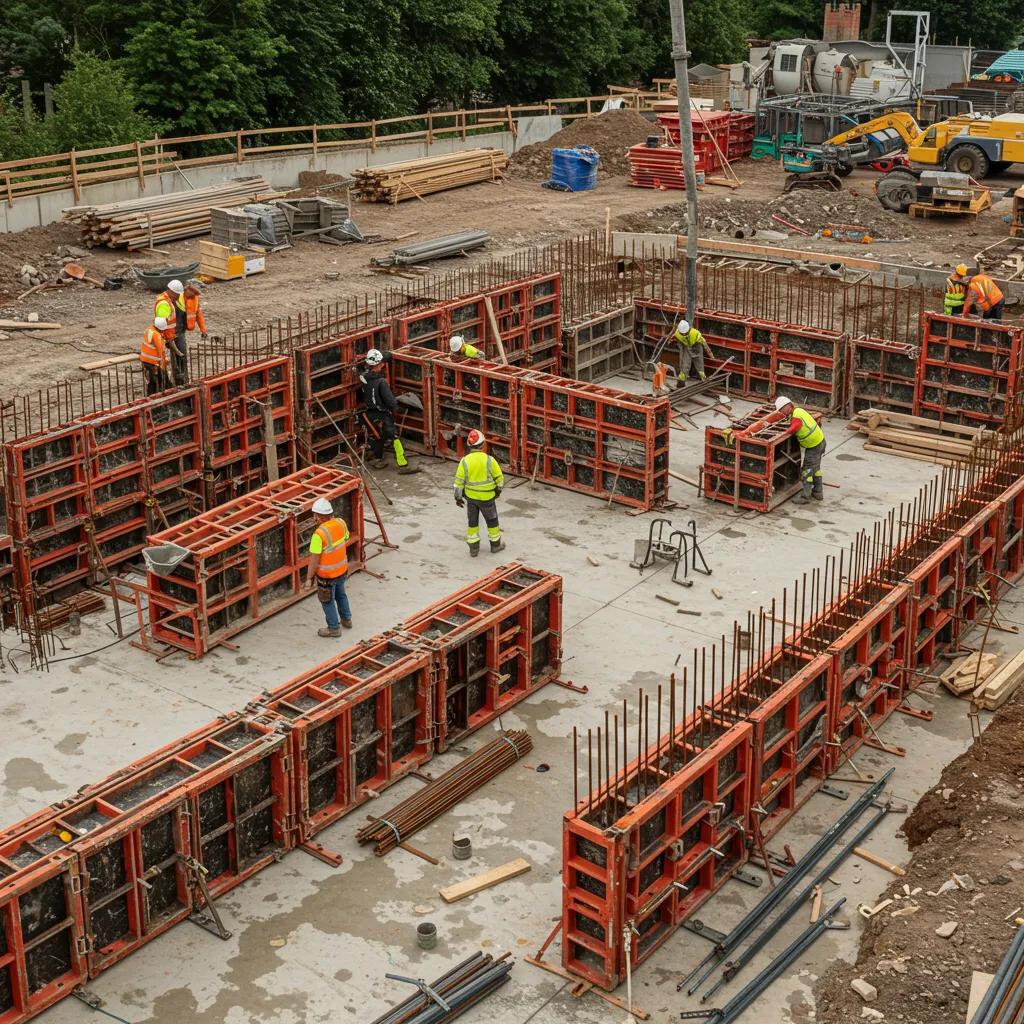
Understanding Formwork for Concrete: Types, Construction Process, and Benefits for Quality Builds
Formwork is the temporary structure that shapes, supports, and confines fresh concrete until it attains sufficient strength to support its own weight and any applied loads; it is fundamental to every quality build because it directly controls geometry, surface finish, and structural tolerances. This article explains how formwork for concrete works, the principal types used on UK sites, the step-by-step construction and quality checks contractors must apply, and the practical benefits that reduce cost and programme risk. Many projects struggle with leakage, deformation, and stripping mistakes that cause rework and delays; targeted formwork selection and engineered temporary works solve those pain points while improving finish and safety. Readers will learn comparative pros and cons of timber, steel, plastic/composite, and modular systems, a contractor-ready installation sequence with QA checkpoints, reinforced concrete formwork specifics, and a localised view of UK regulatory and supplier considerations. Practical lists, specification tables, and troubleshooting matrices are included to support decision-making on site and in procurement. Throughout the guide, keywords such as formwork, timber formwork, steel formwork, modular formwork systems, formwork design, formwork removal, and formwork safety appear in context to aid technical understanding and specification drafting.
What Are the Different Types of Concrete Formwork?
Formwork types are the hyponyms of construction formwork and each type functions by creating a mould that resists wet concrete pressure and maintains shape until stripping; the right choice balances stiffness, reusability, and finish. Materials and system design determine load capacity, handling, and lifecycle cost, so understanding material characteristics is essential before procurement and temporary works design. The following subsections describe common systems and their best-fit uses, with a comparison table to help choose between timber, steel, plastic/composite, modular, and reinforced-concrete-specific approaches. This analysis supports contractors and clients in matching formwork to project repetition, finish requirement, and programme constraints.
This section compares the common formwork types used on-site:
- Timber formwork is primarily on-site fabricated from plywood and framing, ideal for bespoke shapes and small-scale works.
- Steel formwork comprises prefabricated panels for repeatable elements and delivers tight tolerances for multi-unit projects.
- Plastic and composite formwork offer lightweight handling and rapid turnover for small foundations and decorative panels.
- Modular and engineered systems provide fast assembly and high reuse cycles for repetitive high-volume works.
The comparison below summarises materials, uses, and limitations for quick decision-making.
| Formwork Type | Key Materials | Typical Uses / Advantages | Typical Limitations |
|---|---|---|---|
| Timber formwork | Plywood, softwood framing | Low initial cost, adaptable for one-off shapes and site-specific detailing | Limited reuse, variable finish, labour-intensive |
| Steel formwork | Steel panels, frames | High reuse, excellent finish, fast assembly for repetitive works | Higher capital cost, heavier handling, needs plant |
| Plastic / Composite | Polypropylene, GRP panels | Lightweight, corrosion resistant, easy cleaning, quick turnover | Limited load capacity, moderate reuse cycles |
| Modular systems | Engineered panels, aluminium sections | Fast erection, excellent quality control, economy on repetition | Investment cost, may require trained crews |
| Reinforced-concrete-specific | Heavy-duty panels, strong propping | Designed for high loads with integration of rebar and propping systems | Complex temporary works design and strict tolerances |
This table highlights trade-offs so project teams can prioritise stiffness, reuse, and finish when selecting formwork.
How Does Traditional Timber Formwork Work?
Traditional timber formwork is a site-built system that uses plywood facing supported by joists and studs to resist wet concrete pressure, and it works by transferring loads into props and the ground. The mechanism relies on correctly sized members and tight jointing to prevent leakage and deformation, which preserves tolerances and surface appearance. Timber is inexpensive for one-off or complex shapes and allows on-the-spot modifications to match architectural detail, making it common for foundations, bespoke beams, and irregular elements. However, timber formwork has limited reuse, requires careful treatment against moisture, and may produce variable finishes compared with engineered systems. Understanding these practical trade-offs informs whether to use timber for bespoke elements or favour engineered alternatives for larger repetitive programmes.
What Are the Advantages of Steel Formwork?
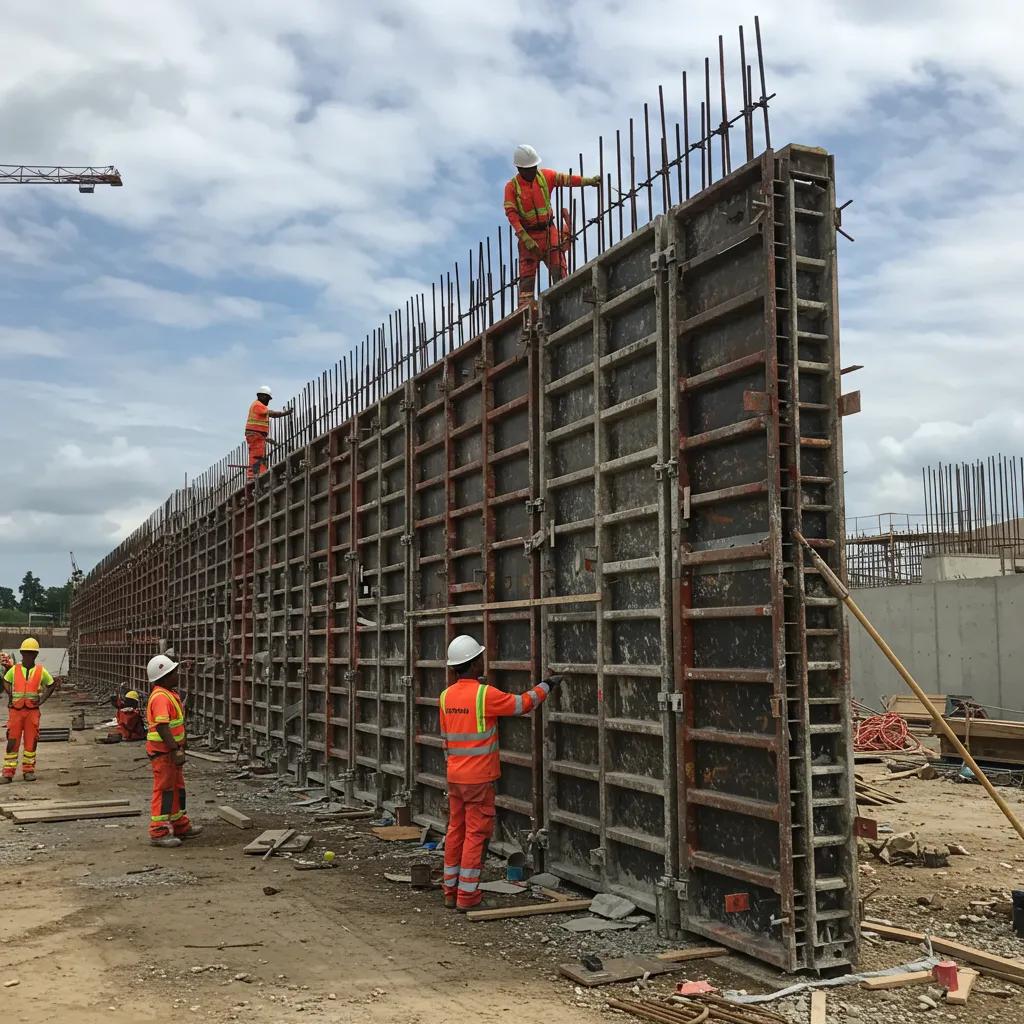
Steel formwork uses engineered panels that interlock and are supported by a grid of walers, joists, and props; this system provides high stiffness and predictable behaviour under lateral wet-concrete pressure. The mechanism of prefabrication and tight joints delivers consistent surface finish and dimensional accuracy, which in turn reduces remedial works and improves final appearance for exposed concrete. Steel systems amortise their higher initial cost across many reuse cycles, making them cost-effective for multi-unit residential blocks, parking structures, and repetitive columns or walls. Maintenance is straightforward—panels are cleaned and inspected between pours—and the robust nature of steel panels shortens assembly time with trained crews. These advantages make steel formwork a preferred choice where programme speed and finish quality are priorities.
When Should You Use Plastic and Composite Formwork?
Plastic and composite formwork are lightweight engineered panels that rely on modern polymers or glass-reinforced materials to create moulds that are easy to handle and quick to clean, improving turnover on small to medium projects. The mechanism focuses on lower unit weight and corrosion resistance, which reduces manual handling risks and enables faster cycle times on repetitive small foundations or decorative panels. Plastic systems excel where a moderate finish is acceptable and where site logistics favour manual assembly without heavy plant, while their reuse cycles are shorter than steel but often longer than single-use timber. Environmental considerations include recyclability of polymer components and lifecycle assessments to compare against timber or steel alternatives. Evaluating reuse expectations and finish needs helps determine when plastic or composite formwork is the cost-effective choice.
What Is Reinforced Concrete Formwork and How Is It Different?
Formwork for reinforced concrete differs because it must accommodate reinforcement placement, congestion, and access for vibration while resisting higher wet-concrete pressures; design tolerances are tighter to ensure required cover and alignment. The mechanism requires coordination between formwork panels, spacers, chairs, and tie systems so that reinforcement remains in the correct position during pouring and vibration, securing structural integrity and durability. Reinforced-concrete formwork demands stronger propping, accurate shuttering interfaces, and detailed temporary works design to handle combined loads and prevent movement that would compromise cover or finish. These factors make reinforced-concrete formwork more demanding to specify and erect, requiring early input from structural and temporary works engineers to avoid costly corrections after casting. Clear coordination protocols between reinforcement fixers and formwork installers minimise clashes and ensure the build meets design intent.
How Is Concrete Formwork Constructed? Step-by-Step Process Explained
Concrete formwork construction follows a defined lifecycle: design and temporary works engineering, fabrication or procurement, site preparation and setting out, installation with propping and bracing, pouring and consolidation, curing, and careful stripping. The process works by sequencing tasks so that each stage verifies the previous one and reduces risk of leakage, deformation, or misalignment, delivering a predictable finished structure. Quality checks carried out at key milestones—pre-pour inspection, reinforcement verification, and propping sign-off—are essential to prevent defects and rework. The subsections below provide a contractor-ready checklist of stages, design considerations for stability, safety controls, and practical stripping guidance.
The numbered sequence below outlines a contractor-friendly installation flow with responsible parties and quality checkpoints.
- Design and temporary works engineering: produce formwork layout and propping calculations with temporary works engineer verification.
- Fabrication/pre-assembly: prepare panels and components off-site where possible to reduce site labour and errors.
- Site set-out and placement: check levels, anchors, and base supports; install panels and secure walers, joists, and ties.
- Pre-pour inspection: verify reinforcement position, propping, joints, and release agent application before concrete arrives.
- Pouring, vibration, and curing: follow pour sequencing, control rate of placement, and allow adequate curing before stripping.
This ordered checklist helps project teams coordinate trades, meet safety duties, and reduce the risk of pour-time failures.
| Stage | Key Activities | Responsible Party | Quality Checks |
|---|---|---|---|
| Temporary works design | Load calculations, propping design, approval | Temporary works engineer / designer | Design verification, calculations signed off |
| Fabrication | Panel assembly, edge details, liners | Fabricator or site carpenters | Dimensional checks, panel condition |
| Site preparation | Setting out, level checks, base support | Contractor/site engineer | Stringlines, laser checks, survey mark |
| Installation | Erection, walers, ties, propping | Formwork crew / supervisor | Alignment, plumb, tie torque checks |
| Pre-pour inspection | Reinforcement, joints, release agent | Site QA / engineer | Inspection report, hold points |
| Pour & curing | Controlled placement, vibration, curing regime | Concrete supplier / contractor | Slump records, temperature, curing logs |
| Stripping | Progressive removal, protection | Formwork crew / supervisor | Strength tests, visual check for damage |
This process table clarifies responsibilities and QA checks for each stage, assisting coordination between structural engineers, temporary works designers, and site teams.
What Are the Key Stages in Formwork Installation?
Formwork installation begins with accurate setting out and base preparation, then proceeds to panel assembly, walers and props placement, and final alignment and inspection before pour. The mechanism emphasises a logical load path from panels through walers to props and into the ground, so each element must be checked for capacity and correct fixing. Pre-pour inspections verify reinforcement position, tie rod integrity, and sealant application to prevent leaks, while a signed hold point ensures no concrete is poured until all checks pass. Effective communication between the temporary works engineer, site supervisor, and reinforcement crew reduces the chance of last-minute changes that can compromise safety or finish. Careful sequencing and documentation at each stage create the foundation for a defect-free pour.
How Is Formwork Designed for Structural Stability?
Formwork stability design considers wet concrete lateral pressure, point loads from equipment, temporary wind loads, and safety factors specified by temporary works guidance to prevent collapse or excessive deflection. The design mechanism calculates prop spacing, waler sizes, and connection details to ensure the formwork assembly remains within acceptable deflection tolerances under peak pressures during placing and vibration. Coordination with structural and temporary works engineers confirms load paths and introduces bracing and ties where necessary to distribute forces safely, and design verification ensures compliance with UK temporary works practice. Documented design checks and approvals before installation reduce liabilities and ensure that formwork performs predictably during the pour. Ensuring appropriate safety factors and verification by competent designers underpins both structural stability and site safety.
What Safety Measures Are Essential During Formwork Construction?
Essential safety measures include provision of PPE, edge protection and access systems, a competent workforce trained in temporary works procedures, and a temporary works register capturing design and inspection records. The mechanism of safe execution relies on prevention—ensuring correct propping and secure fixings—and detection—frequent inspections to catch movement or damage before it becomes critical. Regular inspection frequency with documented checklists, competent supervision, and clear communication protocols for non-conformances reduce the likelihood of incident and support CDM compliance. Emergency procedures and exclusion zones during pours protect workers from falling objects and sudden formwork failures, and integrating safety into the pre-pour hold point enforces discipline. These measures collectively reduce risk and improve the reliability of formwork operations on site.
How Is Formwork Removed Without Damaging Concrete?
Safe stripping of formwork depends on adequate concrete strength, progressive removal sequencing, and protection of cured surfaces to avoid damage to the finished element; the rule is to strip according to design strength milestones rather than fixed time alone. The mechanism uses strength tests and temperature-cured criteria to decide when primary supports can be removed without inducing stresses or deflections that exceed design allowances. Progressive sequencing—removing facing panels first, then props in a staged manner—prevents sudden load redistributions that would crack or distort the concrete. Surface protection and careful handling after stripping preserve finishes and prevent scarring, especially for architectural concrete surfaces. Following measured strength checks and a planned removal sequence ensures longevity and quality of the concrete structure.
What Are the Main Benefits of Using Concrete Formwork?
Correctly specified and executed formwork improves final concrete quality, reduces programme duration, controls costs by minimising remedial work, and enhances site safety through engineered temporary works; these benefits arise from system stiffness, modularity, and proven erection methods. The mechanism by which formwork delivers these outcomes includes improved dimensional control, fewer defects from leakage or movement, and faster cycle times on repetitive elements. Quantifiable benefits for developers and contractors include reduced snag lists, faster handover, and lower life-cycle costs where reusable systems are applied. The subsections below expand how formwork enhances finish, saves time, and improves safety with examples and metrics for contractor decision-making.
Formwork delivers core advantages that affect quality, time, and cost:
- Quality Finish: Stiff systems and tight joints reduce surface blemishes and dimensional variance.
- Time Savings: Modular systems speed up erection and stripping cycles on repetitive work.
- Cost Control: Reduced remedial work and predictable labour lead to lower overall project cost.
These benefits show why investing in appropriate formwork is often cost-effective over a project lifecycle.
How Does Formwork Improve Concrete Quality and Finish?
Formwork impacts finish by providing stiff support and consistent jointing that prevents surface irregularities, honeycombing, and line mismatches; the mechanism is simple: less movement during pour equals a better surface. High-quality panels and accurate assembly maintain alignment and level, preserving architectural tolerances and reducing the need for extensive remedial finishes. Proper sealing and use of form liners also enable desired textures while minimising leakage that causes blowouts and blemishes. Measurable outcomes include fewer rectification hours and lower material wastage, which together improve both programme reliability and client satisfaction. Good formwork practice therefore directly translates into visible, quantifiable improvements in finish quality.
In What Ways Does Formwork Save Time and Reduce Costs?
Formwork saves time and reduces costs through reusability, predictable assembly times, and fewer remedial activities; the mechanism is repeatability—prefabricated systems repeat quickly across multiple units. Modular systems reduce crane time and on-site carpentry, enabling faster cycle times for walls, slabs, and columns which shortens overall programme duration. Cost savings accrue from reduced labour, fewer defects, and lower materials waste, and lifecycle calculations often show that higher initial capital for engineered systems is recouped over successive uses. Planning for reuse and efficient logistics therefore converts formwork choices into tangible programme and budget benefits on medium-to-large projects. This economy of scale is especially apparent on multi-unit residential and car park structures.
How Does Formwork Enhance Construction Safety and Efficiency?
Engineered formwork and proper propping reduce the risk of collapse by ensuring predictable load paths and controlled temporary states during construction; the mechanism is that designed systems remove ad-hoc assumptions and provide verified capacity. Safety is improved through standardised assembly methods, integrated edge protection, and better access routes for crews, which reduce falls and handling incidents. Efficiency gains follow from reduced rework, clearer hold points, and streamlined inspection regimes that speed decision-making before pours. Compliance with temporary works registers and site safety procedures further reduces risk and supports regulatory duties. Together, these factors improve both safety record and programme throughput on site.
For projects in the South of England, our reinforced concrete and formwork teams deliver these benefits to main contractors and developers, combining temporary works expertise with on-site installation experience to improve finish, speed, and cost control. If you need a site visit or an estimate, our teams can discuss your project requirements and provide tailored recommendations for formwork strategy.
What Are the Popular Formwork Systems Used in the UK?
UK projects commonly use a mix of traditional timber, engineered steel panels, modular wall and column systems, slab table systems, and climbing formwork where appropriate; system choice aligns with project scale, repetition, and finish. The mechanism for system selection in the UK includes availability of local supply, hire support, and compliance with temporary works documentation demanded by CDM and local site practice. The subsections detail modular systems in the UK market, practical compliance considerations, and criteria for selecting suppliers without naming specific vendors. This section helps procurement and site teams narrow options based on regulatory fit and local support.
Here are typical UK formwork systems and where they fit best:
- Modular wall and column systems for repetitive residential cores and multi-storey structures.
- Table and slab systems for large-area slabs and car park decks that demand speed.
- Climbing and jump formwork for cores and tall structures where safety and cycle time matter.
Selecting the right supplier involves checking availability, lead times, and local support to match programme needs and regional logistics.
| System Type | Best-Fit Applications | UK Practice Considerations |
|---|---|---|
| Modular wall/column | Multi-unit residential, cores | Hire availability, trained crews |
| Table/slab systems | Car parks, slabs with repeats | Crane scheduling, slab sequencing |
| Climbing formwork | High-rise cores | Specialist design, lifting plans |
| Timber (site-built) | One-offs, complex shapes | Local carpentry skills, waste management |
The table clarifies how system selection maps to UK project types and practical constraints.
Which Modular Formwork Systems Are Common in the UK Market?
Modular systems in the UK include engineered panel systems for walls and columns, large-area slab tables, and climbing systems for cores; each system speeds repetitive work by standardising connections and propping. The mechanism of modularity reduces on-site carpentry and enables predictable cycle times through repeated configuration and trained crews. Common uses include residential blocks, multi-storey car parks, and stair/core construction where repetition and quality are priorities. Project teams should evaluate module dimensions, assembly time, and compatibility with local craneage and transport to ensure system fit. Local availability and trained operatives are decisive in real-world selection.
How Do UK Formwork Systems Comply with Building Regulations?
Compliance requires that formwork and temporary works are considered within structural safety, durability, and fire-performance contexts and that CDM duties and temporary works registers are maintained on site. The mechanism is documentation and verification: designs must be checked and recorded, inspection regimes must be logged, and any temporary works design must be signed off by competent personnel. Practical checkpoints include temporary works design approval, method statements, lifting plans, and evidence of inspection before pours. Ensuring these records are in place avoids regulatory issues and improves risk management across the build. Good compliance practice therefore integrates formwork planning with project health and safety systems.
What Are the Leading UK Suppliers and Manufacturers of Formwork?
Choosing suppliers should focus on service levels, warranty, local availability, and the ability to support site-specific needs rather than brand alone; the mechanism is evaluating supplier capability against project logistics and programme needs. Supplier selection criteria include response times for replacements, on-site technical support, spares availability, and hire fleet condition to avoid hold-ups. For projects in the South of England, local availability and responsive technical assistance shorten lead times and solve erection issues quickly. Evaluating supplier references, maintenance practices, and service contracts helps ensure reliable performance for the life of the hire or purchase cycle.
How Does Reinforced Concrete Formwork Support Structural Integrity?
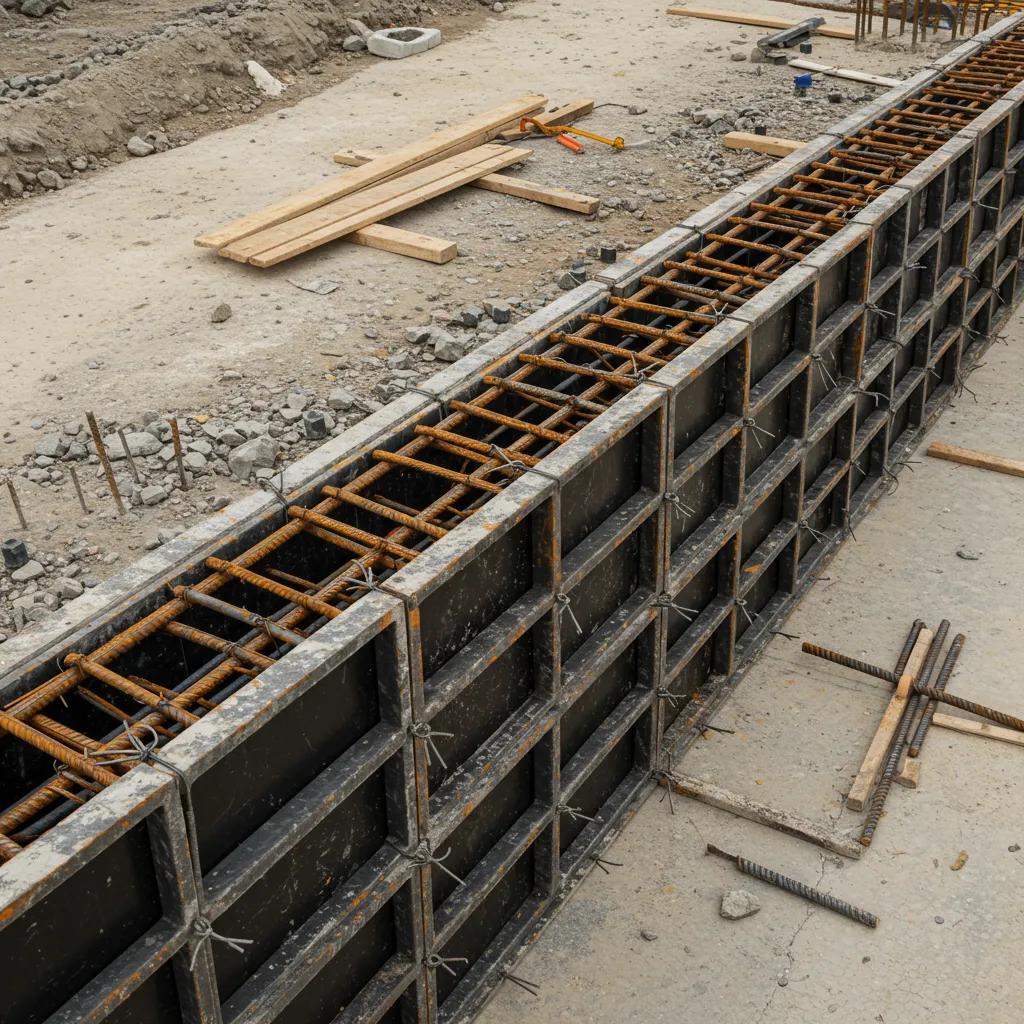
Reinforced concrete formwork supports structural integrity by ensuring reinforcement is positioned and maintained to achieve designed cover, alignment, and compaction so the in-situ concrete attains intended strength and durability. The mechanism requires an integrated approach where panel design, chairs, spacers, and propping work together to prevent displacement during placing and vibration. Coordination with reinforcement fixers, access planning for vibration, and temporary works verification are essential to avoid congestion-related defects. The subsections below detail materials used, reinforcement integration practices, and common challenges with practical solutions.
Materials and components used in reinforced formwork include panels, walers, ties, props, chairs, and cover blocks that collectively maintain geometry and load paths.
| Component | Role | Performance Requirement |
|---|---|---|
| Panels | Face finish, contain concrete | Stiffness, impermeability |
| Walers & joists | Distribute loads | Adequate section modulus |
| Props & shores | Support vertical loads | Adjustable and load-rated |
| Ties & anchors | Resist lateral thrust | Correct spacing and capacity |
| Spacers & chairs | Maintain reinforcement cover | Non-reactive material and correct height |
This component table highlights the elements that must function together for reinforced concrete to meet design criteria.
What Materials Are Used in Reinforced Concrete Formwork?
Common materials include plywood or steel facing panels, steel walers and joists, adjustable props, and certified tie systems; each material is chosen for stiffness, durability, and compatibility with rebar detailing. The mechanism for material selection balances load resistance, surface finish requirements, and expected reuse cycles to determine whether timber-faced or steel panels are appropriate. Critical supporting items such as chairs, spacers, and durable ties ensure required cover and prevent corrosion risks that could arise from contact with formwork materials. Selecting appropriate materials reduces the risk of movement during vibration and preserves designed durability. Regular inspection and maintenance of components also extend service life and reliability.
How Is Reinforcement Integrated Within Formwork?
Reinforcement is integrated by placing bars on chairs and spacers fixed to the formwork layout, verifying cover and lap lengths, and maintaining access for vibration and inspection prior to pour; the mechanism is precise positioning and locking of reinforcement to prevent displacement. Inspection checkpoints confirm bar positions relative to form faces, check chair integrity, and ensure ties and supports will not move during placing. Coordination between fixing teams and formwork installers, with signed-off checklists, reduces the risk of congestion that can impede compaction and compromise strength. Practical examples include providing temporary access zones for vibrators and confirming cover blocks are non-reactive and secure. These steps ensure reinforcement achieves its structural role without compromise.
What Are the Challenges and Solutions in Reinforced Formwork Construction?
Typical challenges include congested reinforcement restricting vibration access, formwork movement under pressure, and difficulty achieving required cover in complex details; solutions involve alternative formwork layouts, staged pours, and increased propping or bespoke panels. The mechanism of mitigation often requires temporary works design adjustments such as additional walers, reduced panel spans, or pre-assembled cage inserts to ease handling and placement. Early involvement of temporary works engineers and clear sequencing between fixers and formwork crews prevents last-minute clashes and enables smoother pours. When access is constrained, using smaller concrete pours or pumped placement with internal vibrators preserves compaction quality. These strategies manage risk and maintain structural integrity.
How Can You Choose the Right Formwork for Your Concrete Project?
Choosing formwork requires a decision framework that weighs project repetition, required finish, budget, programme, site access, and environmental impact; the mechanism is prioritising criteria against project objectives to select the most appropriate system. A clear checklist helps teams evaluate short-term cost versus life-cycle value and balances labour availability with plant and supplier support. The subsections provide a selection checklist, guidance on how project size alters choices, and an environmental comparison of material footprints to support sustainable procurement. Applying this decision process reduces procurement errors and improves on-site performance.
The decision checklist below summarises the primary factors to evaluate when selecting formwork.
- Project repetition and scale: choose modular systems for high repetition to achieve economy of scale.
- Finish and tolerance requirements: specify engineered panels where exposed finishes are required.
- Budget and life-cycle cost: evaluate capital cost versus reuse and remediation savings.
- Site access and labour: factor in weight/handling, crane availability, and available skilled operatives.
- Environmental considerations: consider reuse cycles and material recyclability in selection.
This checklist guides procurement teams toward a balanced choice aligned with project priorities.
| Selection Factor | What to Assess | Impact on Choice |
|---|---|---|
| Repetition | Number of identical elements | Favors modular/steel systems |
| Finish | Surface quality needed | Prefers steel or lined panels |
| Budget | Capital vs lifecycle cost | Guides hire vs purchase decision |
| Site logistics | Crane, access, storage | Influences panel size and weight |
| Sustainability | Reuse and recycling | Favors systems with longer life |
The table helps quantify selection factors for clearer decision-making.
What Factors Influence Formwork Selection?
Critical factors include the degree of repetition, required surface finish, load and height of elements, programme constraints, available labour, and site access limitations; the mechanism is weighting these factors against each other to choose the dominant driver. For example, a high-repetition residential block prioritises modular systems to shorten cycles, while a bespoke architectural element may require timber for flexibility despite higher labour. Programme pressures can force heavier investment in engineered systems to save time, whereas constrained access may mandate smaller, manual-handled panels. Environmental and waste-management objectives also influence whether to prefer reusable steel or recyclable plastic over single-use timber. Prioritising these criteria early reduces procurement changes and site delays.
How Do Project Size and Complexity Affect Formwork Choice?
Smaller, one-off projects often favour timber or light composite systems because of low capital commitment and flexibility, while medium-to-large repeated elements benefit from modular steel or table systems that deliver faster cycles and better finish. The mechanism here is economy of scale: higher repetition lowers per-unit cost for engineered systems and justifies hire fleets or purchase. Complex architectural forms may still need bespoke shuttering and skilled carpentry regardless of scale, but integrating engineered elements where possible reduces time and defect risk. Project examples show single houses often use timber, whereas blocks of flats typically use modular wall and slab table systems to maximise programme efficiency. Matching system capability to project complexity yields predictable outcomes.
What Are the Environmental Impacts of Different Formwork Types?
Environmental impact varies by material lifecycle: single-use timber generates waste if not sustainably sourced or reused, while steel and plastic systems have higher embedded energy but lower waste through extended reuse cycles; the mechanism is lifecycle assessment that balances embodied carbon with reuse potential. Reusable systems reduce waste streams and often deliver lower net environmental impact over multiple projects, whereas poorly managed timber can create disposal burdens and higher cumulative impacts. Considerations include sustainably sourced timber, recycling streams for plastics and steel reclamation practices to minimise landfill. Procurement teams should include reuse expectations and end-of-life handling in tender evaluations to make sustainable choices. Lifecycle thinking therefore shifts decisions from upfront cost to longer-term environmental outcomes.
For tailored recommendations based on your site, logistics, and finish requirements, our team offers free consultation and quotation to help identify the most suitable formwork approach for your project scope and programme.
What Are Common Issues in Concrete Formwork and How Can They Be Avoided?
Common issues include formwork leakage and blowouts, deformation under load, misalignment, and poor leveling; each failure mode has identifiable causes and practical prevention techniques that reduce site rework and improve quality. The mechanism of prevention is systematic pre-pour checks, adequate propping, and correct tie systems combined with inspection protocols to catch issues early. A troubleshooting table below maps common problems to causes and mitigations, while subsections give actionable checklists for leakage prevention, deformation control, and alignment verification. Following these practices reduces defects and supports predictable project delivery.
Frequent formwork problems and their simple mitigations include:
- Seal joints and torque ties to prevent leakage and blowouts.
- Increase bracing or reduce panel spans to avoid deflection.
- Use laser levels and survey checks to maintain alignment and level.
This short list captures primary defensive measures applicable across most site scenarios.
| Issue | Cause | Prevention / Mitigation |
|---|---|---|
| Leakage / blowout | Poor jointing, inadequate ties | Proper sealing, correct tie spacing and torque checks |
| Deformation | Insufficient props, long spans | Increase propping, add walers or reduce span |
| Misalignment | Inaccurate setting out | Laser control, stringlines, survey verification |
| Surface blemish | Movement or leakage | Stiffer panels, lined faces, immediate repair of leaks |
This troubleshooting table provides quick reference actions to reduce rework and defects.
How to Prevent Formwork Leakage and Concrete Blowouts?
Leakage and blowouts occur when joints are not sealed, ties are underspecified, or pressures exceed design assumptions; prevention relies on correct joint detailing, confirmed tie capacity, and pre-pour pressure checks. The mechanism is simple: ensure all formwork joints are sealed with appropriate gaskets or sealants, verify tie rod integrity and spacing against design pressures, and confirm that propping can resist lateral thrust. A pre-pour checklist should include visual checks of all joints, torque testing of ties, and a documented hold point before concrete arrives. Immediate mitigation for high-risk pours includes reducing pour rate, providing secondary supports, and using cofferdams or internal bracing. These steps significantly reduce the chance of sudden blowouts.
What Causes Formwork Deformation and How to Minimise It?
Deformation typically stems from insufficient stiffness, inadequate propping, excessive panel spans, or unexpected loading and is minimised by increasing walers, reducing unsupported spans, and using stiffer panels or additional shores. The mechanism is to design for the worst-case lateral pressure and provide adequate section modulus in walers and joists to keep deflection within acceptable limits. On site, monitor deflection during pours and add temporary bracing if movement is detected, and ensure props are correctly set and checked for settlement. Acceptable tolerances should be specified in drawings and verified by survey when necessary. These measures limit deflection-related defects and preserve concrete geometry.
How to Ensure Proper Alignment and Leveling of Formwork?
Proper alignment and leveling use precise setting out, laser levels, control strings, and survey verification to guarantee the formwork matches design dimensions and slopes; the mechanism is continuous verification during assembly and immediately before pouring. A practical checklist should include initial survey of datum points, progressive checks at each bay, verification of plumb and level on walers and a final survey sign-off at the pre-pour hold point. Temporary adjustments can be made using packers or adjustable props but must be recorded and rechecked after any loading event. Final verification ensures compatibility with finishes and reduces remedial surfacing work. This disciplined verification practice is fundamental to achieving structural and architectural tolerances.
How to Prevent Formwork Leakage and Concrete Blowouts?
Formwork leakage prevention emphasises joint sealing, correct tie specification, and pre-pour pressure calculations to ensure formwork resists lateral loads; the mechanism is that well-sealed and adequately tied systems prevent cement paste escape and sudden blowouts. Conduct joint inspections, apply appropriate release agents and seal tape where interfaces occur, and confirm tie systems are in good condition and torqued to specification. A pre-pour checklist and hold point reduce risk by requiring documented verification before concrete arrives. If pressures are higher than expected, reduce pour rates or add temporary bracing to maintain system integrity.
What Causes Formwork Deformation and How to Minimise It?
Deformation arises from insufficient support, long unsupported spans, and underestimated loads; minimisation requires adding walers, reducing unsupported spans, increasing prop density, and using stiffer facing materials. The mechanism is increasing section stiffness and shortening unsupported spans to reduce bending and deflection under wet-concrete loads. On-site monitoring and immediate reinforcement of any observed movement prevent progressive defects. Design-level measures include conservative load assumptions and appropriate safety factors applied by the temporary works engineer. These actions maintain geometry and reduce the need for remedial works.
How to Ensure Proper Alignment and Leveling of Formwork?
Ensuring alignment and leveling depends on accurate setting out, use of laser levels, control strings, and progressive surveys at installation and immediately before the pour; the mechanism is continuous verification that prevents cumulative errors across bays. Implement a documented survey regime, check plumb and level of walers and panels, and apply corrective packers or adjustable props where necessary with re-verification. A final pre-pour survey sign-off enforces accountability and ensures that finished concrete meets dimensional and aesthetic requirements. This verification reduces delays from corrective works and preserves design intent.