
From Groundworks to Concrete: How Skilled Groundworkers Lay the Foundation for Every Project
Groundworks are the essential preparatory and substructure activities that determine whether a building stands plumb, performs as designed, and remains durable over time. This article explains how site preparation contractors, skilled groundworkers, and concrete foundation specialists move a project from initial clearance and excavation through precision formwork, reinforced concrete frame construction, and specialist basement works. Readers will learn the key stages of groundworks, how different formwork systems influence structural outcomes, why reinforced concrete and steel reinforcement are chosen for load-bearing frames, and the concreting practices that ensure longevity. The guidance that follows addresses practical choices—foundation types, drainage systems, ground stabilisation, and finishing techniques—so decision-makers in residential, commercial, and civil projects can evaluate options and manage risk. Throughout, we draw on regional practice relevant to Surrey and London, reference sustainability and health & safety considerations, and indicate where an integrated contractor can streamline delivery for complex sites.
What Are Groundworks and Why Are They Essential for Construction Projects?
Groundworks are the collection of preparatory civil engineering tasks—site clearance, excavation, drainage, and foundation preparation—that create a stable platform for structural works and long-term performance. By removing unsuitable materials, testing and stabilising subsoils, and installing designed drainage and ground beams, groundworkers reduce settlement risk and create correct load-bearing conditions that protect structural integrity. Proper groundworks lower lifecycle costs by preventing water ingress, differential settlement, and expensive remedial works, and they create predictable conditions for formwork and concrete pouring. The next paragraphs break down the core sub-tasks, show how stability is assured through testing and compaction, and then outline what local groundworks providers deliver for Surrey and London projects.
What Does Groundworks Include? Site Clearance, Excavation, and Drainage Explained
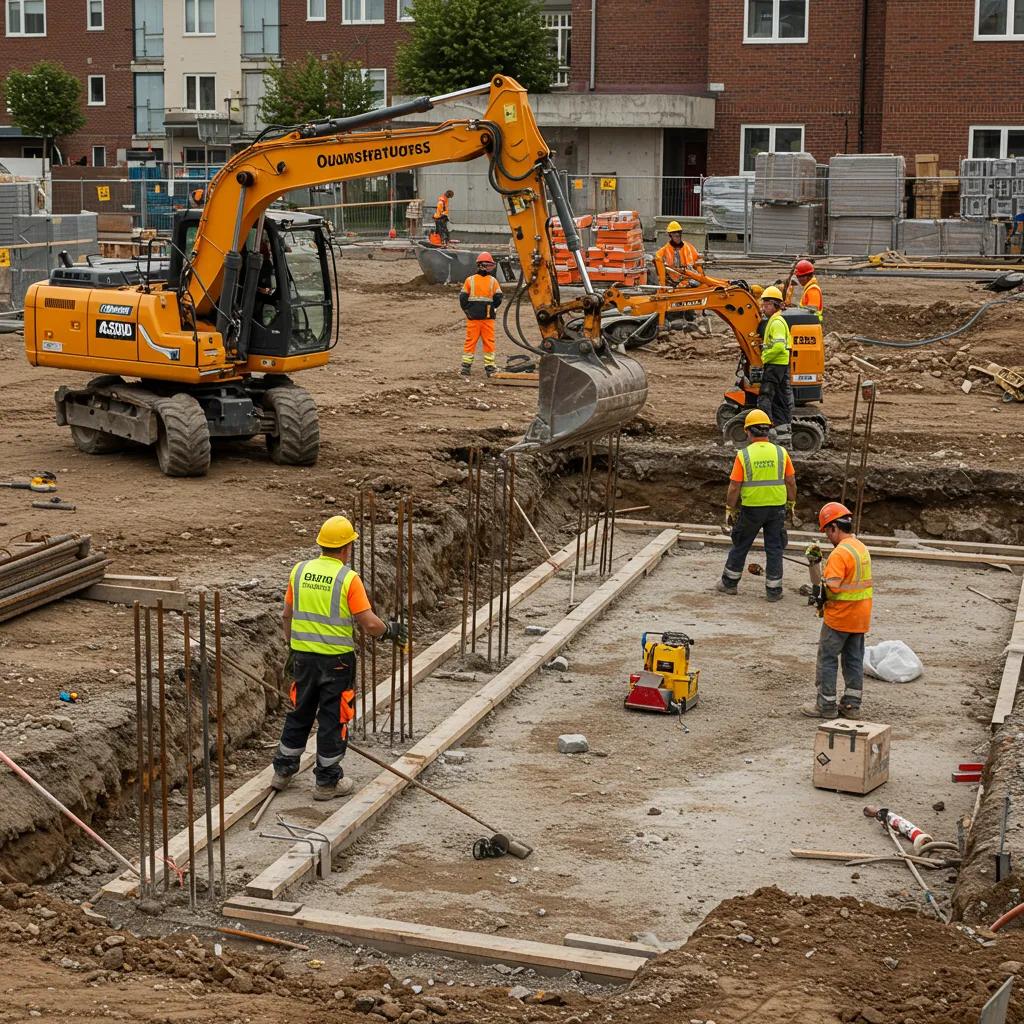
Site clearance removes vegetation, topsoil, and obstructions to expose consistent subgrade and allow accurate setting-out and survey control. Excavation follows with targeted removal to the design levels for strip foundations, pads, or basement envelopes; methods range from controlled bulk excavation to stepped trenches in constrained urban sites. Drainage installation places formation layers, soakaways, or piped systems and connections that protect foundations from hydrostatic pressure and surface water; correct falls and inspection chambers are set to engineering tolerances. Each step uses specialist plant, testing, and compaction to achieve specification, then hands over a stable formation for formwork and reinforcement installation.
Before moving to formwork design and reinforcement detailing, it is important to confirm site stability through testing and compaction certification to avoid rework and ensure the success of the foundation stage.
| Groundworks Phase | Typical Specification | When Required |
|---|---|---|
| Site Clearance | Remove topsoil, vegetation, soft spots to formation level | At project start to enable setting-out |
| Excavation | Depths to foundation level; stepped or shored where required | For foundations, basements, ground beams |
| Drainage Installation | Pipework with falls, inspection chambers, soakaways or attenuation | Where water table or surface runoff threatens substructure |
| Ground Stabilisation | CBR improvement, stone columns, lime/cement treatment | Weak or organic subsoils, high settlement risk |
This table clarifies common groundworks sub-services, their specifications, and typical triggers so clients can match ground conditions to required interventions.
How Do Skilled Groundworkers Ensure Site Stability and Foundation Readiness?
Skilled groundworkers ensure site stability through a sequence of investigation, testing, ground improvement, and verification that turns variable ground into predictable support for structures. The process begins with site investigation and soil testing to identify bearing capacity, groundwater levels, and contamination risks, then proceeds to engineered solutions such as compaction to specified density, stone or geotextile separation layers, and temporary shoring or propping for deep excavations. Quality assurance steps include in-situ tests, compaction records, and survey checks before reinforcement or formwork is installed—these reduce the chance of differential settlement and provide the design-makers with documented compliance. The paragraph that follows explains the range of groundworks services provided by local contractors and how accredited teams manage safety and regulatory duties on site.
What Groundworks Services Does B&R Steel Ltd Provide in Surrey and London?
B&R Steel Ltd operates as a local groundworks and reinforced concrete specialist offering end-to-end substructure services tailored for Surrey and London projects across residential, commercial, industrial, and civil sectors. Their workstream covers site clearance, excavation, drainage, ground beams, and basement preparation implemented by teams accredited to recognised health & safety standards. The company positions itself as an information hub and lead generation service with family experience in the construction industry and specialisation in reinforced concrete, RC structures, and basements. Prospective clients seeking local expertise can contact B&R Steel Ltd by phone for enquiries and quotes; the business integrates groundworks delivery into RC framing and concreting packages to reduce interfaces and programme risk.
The next section examines how formwork supports concrete work, linking preparation to the precision required for safe and durable structural elements.
How Does Formwork Support Concrete Construction?
Formwork is the temporary mould or support system that shapes fresh concrete, controls alignment, and holds reinforcement in position until the concrete cures and develops strength. It functions both as a geometric constraint and a support mechanism, allowing accurate tolerances, smooth finishes, and safe construction sequencing that directly affect structural performance and finishing quality. Good formwork reduces rework, speeds cycles between pours, and ensures the designed load paths are established correctly when the concrete reaches strength. The subsections below compare common systems, explain the case for precision formwork, and describe how regional contractors deliver practical formwork solutions on constrained sites.
What Are the Different Types of Formwork Systems Used in Construction?
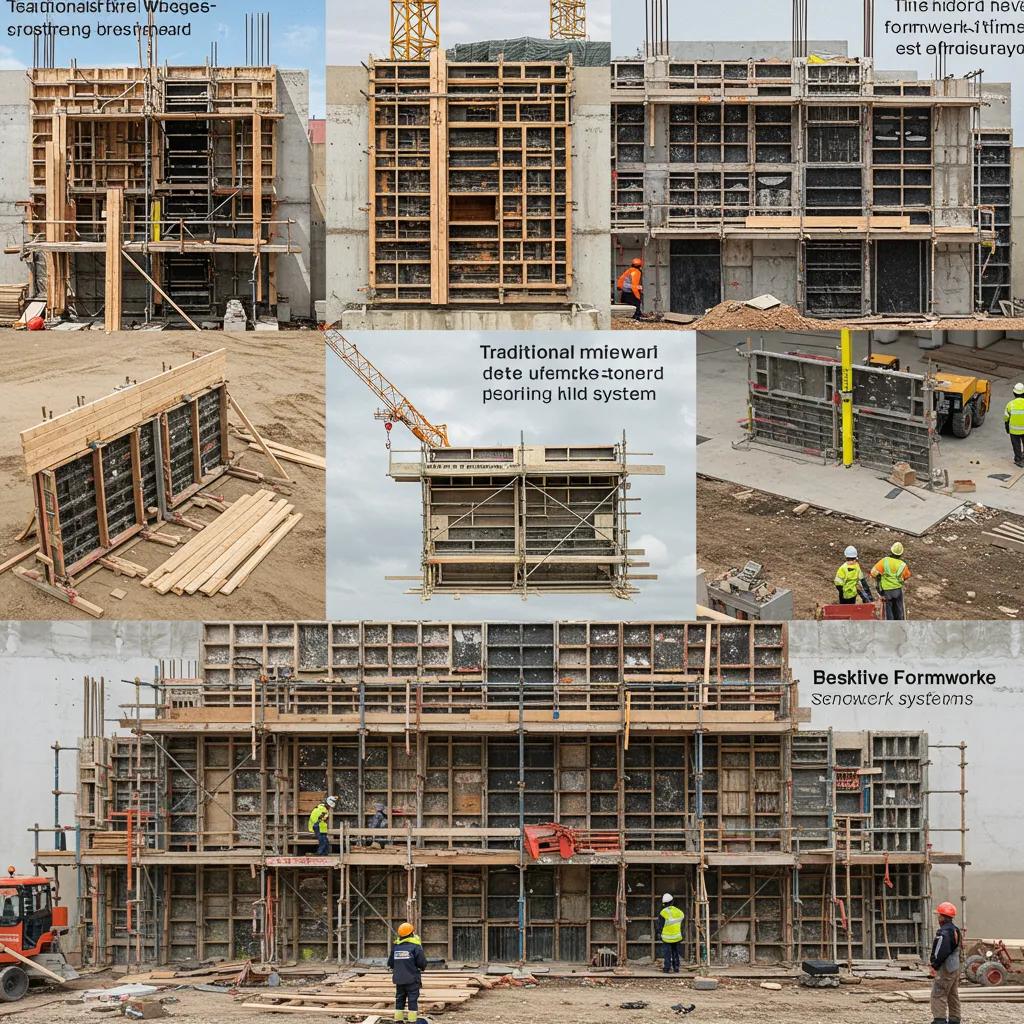
Formwork systems vary by material and modularity: traditional timber formwork is flexible and low-cost for small works; engineered panel systems offer rapid assembly and reuse for medium- to large-scale projects; bespoke or specialist formwork suits complex geometries such as lift shafts or stair cores. Selection balances speed, cost per use, and finish quality: panel systems typically reduce labour and produce consistent tolerances, while timber or bespoke shuttering may lower upfront cost on one-off residential jobs. Project specifics—pour size, cycle time, finish requirement, and site access—determine the optimal system choice.
Formwork type selection leads directly to why precision and alignment matter for structural performance and concrete finishes, which the next subsection examines.
- Timber formwork: flexible, lower capital cost, good for small or bespoke elements.
- Engineered panel systems: rapid assembly, repeatable tolerances, cost-effective on larger projects.
- Specialist/bespoke formwork: required for complex shapes, premium finish or constrained spaces.
Why Is Precision Formwork Critical for Structural Integrity?
Precision formwork ensures alignment, correct dimensions, and surface tolerances, so structural elements meet design loads and interfaces fit as intended; misalignment can alter load paths and create stress concentrations. Tight tolerances reduce the need for remedial strengthening, yield consistent concrete covers for reinforcement protection, and improve waterproofing interfaces in basements and retaining walls. Quality assurance involves template checks, plumb and level surveys, and systematic formwork maintenance to prevent movement during the pour. Having set tolerances secured, contractors can proceed to reinforcement fixing and scheduled pours with reduced risk of structural or finish defects.
Formwork Deflection Measurement System for Construction Site Safety
In this study, a l
Development of a Formwork Deflection Measurement System for Construction Site Safety and Quality Assurance, N Doğan, 2025
Ensuring the accuracy and stability of formwork is paramount, as demonstrated by systems designed specifically for site safety and quality assurance.
How Does B&R Steel Ltd Deliver Expert Formwork Solutions in South East England?
B&R Steel Ltd provides formwork services integrated with its reinforced concrete capabilities, using appropriate panel and specialist systems to match programme needs and finish specifications for London and Surrey projects. Their approach pairs on-site teams experienced in setting tolerances and aligning reinforcement with a project delivery model that supports RC frame pours, lift shafts, and stair cores. Proof points include the company’s focus on RC structures and basements, regional delivery across residential and commercial sectors, and the ability to coordinate formwork, reinforcement, and concreting to reduce handover risk. Clients seeking project-specific detail can contact B&R Steel Ltd by phone for tailored advice or quotations.
These formwork practices lead into the mechanics of reinforced concrete and how steel reinforcement creates resilient structural frames.
| Formwork System | Characteristic | Best Use Case |
|---|---|---|
| Timber | Low capital cost, adaptable | One-off residential elements, bespoke shapes |
| Engineered panels | Rapid reuse, consistent tolerances | Repetitive medium-large pours like slabs and walls |
| Specialist formwork | Custom shapes, premium finish | Lift shafts, complex architectural features |
What Is Reinforced Concrete and How Does It Strengthen Building Foundations?
Reinforced concrete combines concrete’s compressive strength with steel reinforcement’s tensile capacity to produce structural elements that resist bending, shear, and axial loads reliably. The mechanism works because concrete protects steel from corrosion while carrying compression, and steel bars (rebar) take tensile stresses, enabling slabs, columns, and ground beams to span, support loads, and control deflection. Reinforced concrete offers design flexibility, fire resistance, and long service life when cover, detailing, and concrete mix design are correctly executed. The following subsections describe RC frame construction, why contractors specialising in RC frames matter, and how reinforcement enhances durability and safety.
How Are Reinforced Concrete Frames Constructed and What Are Their Benefits?
RC frame construction follows a sequence: formwork and propping are set, steel reinforcement is fixed to design layouts, concrete is poured with appropriate compaction and finishing, and curing proceeds to achieve specified strengths before loading. Benefits include predictable structural behaviour, the ability to create large column-free spaces, and robustness in fire and impact scenarios; RC frames also integrate readily with basement envelopes and ground beams. Typical applications span multi-storey residential and commercial buildings, basements, and civil structures where load capacity and durability are priorities.
Understanding these construction stages makes it easier to identify why a specialist contractor for RC frames adds value, which the next subsection explores.
Key structural benefits of RC frames:
- High load-bearing capacity with predictable deformation behaviour.
- Fire resistance and mass benefit for acoustic and thermal performance.
- Flexibility in architectural and structural layouts for varied programme needs.
What Makes B&R Steel Ltd a Leading Reinforced Concrete Frame Contractor in London?
B&R Steel Ltd highlights specialisation in reinforced concrete, RC structures, and basements alongside family construction experience and a regional focus on London and Surrey projects. The company emphasises comprehensive services that span steel reinforcement fixing, formwork coordination, and concreting to deliver RC frames and substructures with fewer subcontract interfaces. Health & safety accreditations and sustainability measures are part of their client-facing profile, supporting safe site delivery and waste minimisation. For clients requiring reinforced concrete frame expertise in London, B&R Steel Ltd offers local knowledge and integrated delivery to reduce programme risk and coordination overheads.
How Does Steel Reinforcement Enhance Concrete Durability and Safety?
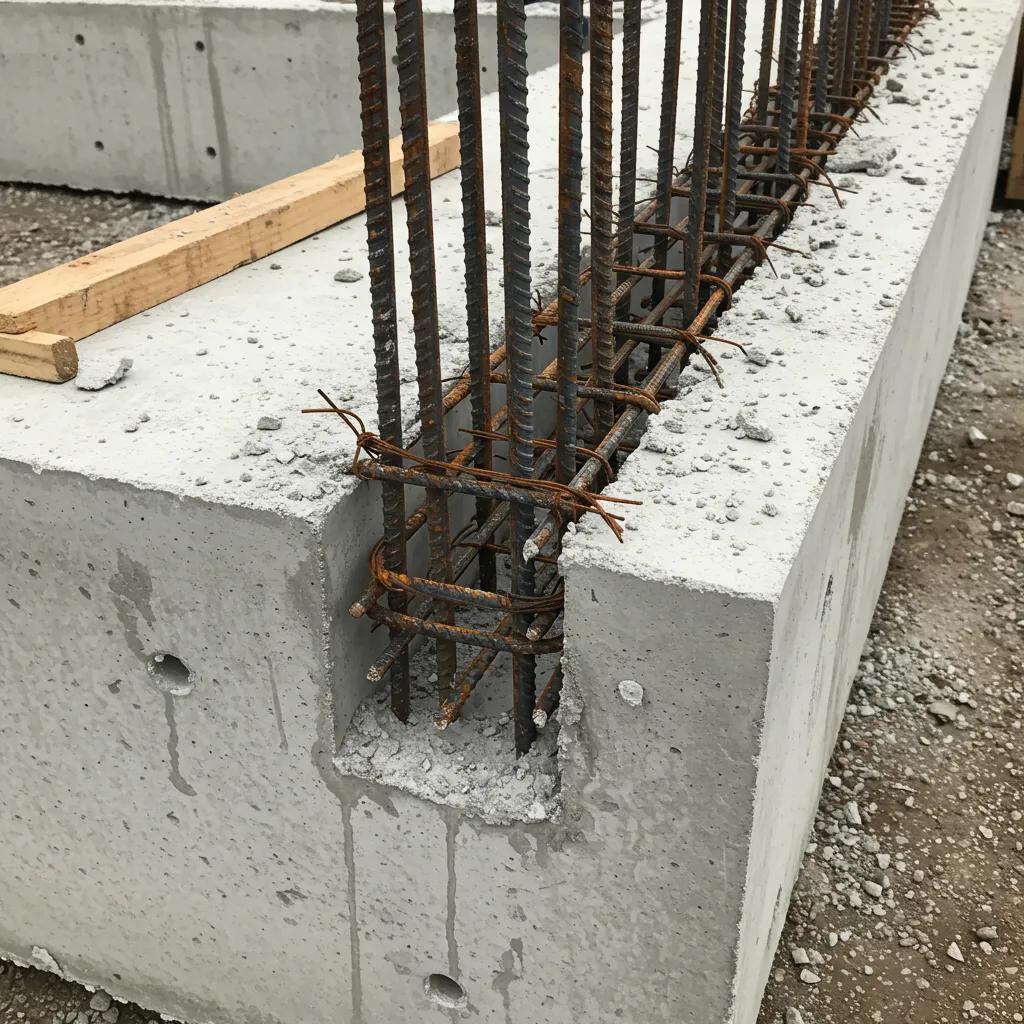
Steel reinforcement carries tensile stresses that plain concrete cannot resist, controlling crack widths and ensuring ductile failure modes that are safer under overload conditions. Durability depends on correct concrete cover, corrosion protection, and appropriate bar detailing; maintenance of cover and use of protective measures such as corrosion inhibitors or adequate concrete mix design extend service life. Designers specify rebar size, spacing, and anchorage to match load paths and limit deflections, and quality control during fixing and pouring ensures the intended performance. Proper reinforcement practice therefore delivers both immediate structural integrity and long-term resilience against environmental exposure.
| Reinforced Element | Typical Function | Typical Use-Case |
|---|---|---|
| RC Frame | Carry vertical and lateral loads | Multi-storey buildings, basements |
| Ground Beam | Distribute loads to strip foundations | Load transfer across poor ground |
| Concrete Slab | Provide floor plate and diaphragm action | Residential and commercial floors |
What Are the Key Steps in the Concreting Process from Foundation to Finish?
The concreting process moves from preparation and verification to controlled pouring, finishing, and curing—each stage protecting strength development and durability. Preparation includes formwork checks, reinforcement verification, and site QA tests (slump, ambient conditions), while pours require vibration control and sequencing to avoid cold joints. Finishing selects surface profiles and jointing appropriate to function, and curing preserves moisture and temperature for required strength gain. The subsections provide practical guidance on pouring and finishing, specialist concreting for basements and ground beams, and how an integrated contractor ensures durable outcomes.
How Is Concrete Poured and Finished to Ensure Longevity?
Concrete pouring follows confirmed preparation: verified formwork and reinforcement, approved mix design, and recorded site conditions; selection of pump or direct discharge depends on access and pour size. Vibration and compaction eliminate voids while timing of finishing—trowel, floating, or broom finish—matches performance needs, and jointing prevents uncontrolled cracking. Curing is essential: keeping concrete moist and within temperature bands during the early days preserves strength and reduces shrinkage cracking; testing regimes such as cube tests verify compressive strength. These practices together ensure surface durability and structural performance over the building life.
The next subsection outlines specialist concreting tasks commonly applied to basements, ground beams, and retaining walls.
Best-practice steps for a controlled pour:
- Confirm QS and engineer sign-off on formwork and reinforcement dimensions.
- Use appropriate placing methods (pump, bucket, or tremie) based on site constraints.
- Conduct on-site testing (slump, air content) and begin curing immediately after finishing.
What Specialist Concreting Works Are Offered for Basements, Ground Beams, and Retaining Walls?
Specialist concreting tasks include watertight basement pours with coordinated waterproofing interfaces, reinforced ground beam construction to transfer loads across variable soils, and retaining wall pours that integrate drainage, weep systems, and appropriate reinforcement. Waterproofing interfaces require correct joint detailing, concrete cover, and surface finishes to ensure membrane adhesion or secondary protection. Retaining structures must account for earth pressures and drainage to avoid hydrostatic loads, while ground beams often require staged pours and careful connection to pads or piled elements. These specialist tasks demand coordination between formwork, reinforcement, and waterproofing trades.
Accurate specialist concrete execution leads naturally to procedures contractors use to guarantee durable solutions, which the following subsection details.
How Does B&R Steel Ltd Guarantee Durable Concrete Solutions Across Projects?
B&R Steel Ltd emphasises material selection, mix specification adherence, and on-site testing as core controls for durability across projects in London and Surrey. Their teams implement QA regimes including slump and cube testing, controlled curing practices, and experienced finishing crews to achieve designed cover and surface outcomes. The company also promotes coordinated delivery between reinforcement fixing, formwork, and concreting crews to reduce cold joints and ensure continuous pours where necessary. Clients can use these measures as selection criteria when comparing commercial concrete contractors and seeking durable structural solutions.
| Concreting Phase | Control Measure | Desired Outcome |
|---|---|---|
| Mix & Delivery | Specified mix and on-site slump tests | Consistent strength and workability |
| Placement | Vibration and sequencing controls | Void-free concrete and proper consolidation |
| Curing & Testing | Moist cure, cube tests | Achieve design compressive strength |
Why Are Skilled Groundworkers Vital for Successful Construction Projects?
Skilled groundworkers bring technical know-how in site set-out, drainage engineering, substructure execution, and temporary works that reduce programme risk and ensure compliance with design. Their expertise means fewer interfaces to manage, lower chance of errors during reinforcement fixing or pours, and a stronger safety culture on site that aligns with regulatory expectations. By coordinating groundworks, formwork, and concrete trades, skilled teams shorten handover times, reduce remedial costs, and improve finished outcomes. The subsections below expand on qualifications and safety standards, integrated service benefits, and how a contractor’s sustainability and health & safety commitments influence project selection.
What Expertise and Safety Standards Do Skilled Groundworkers Bring?
Skilled groundworkers possess competencies in surveying, earthworks management, setting out, and temporary works alongside familiarity with industry certifications that demonstrate safe working practices. On-site procedures include risk assessments, permit-to-work systems, correct PPE usage, and systematic checks for excavation shoring and vibration impacts. Certifications and accreditations—commonly cited in the industry—support compliance and help principal contractors demonstrate due diligence. A safe, well-documented approach reduces accidents and avoids programme delays caused by remedial works or enforcement actions.
Typical safety and competency measures:
- Competent site supervisors and trained operatives for excavation and shoring works.
- Documented risk assessments and daily checks for temporary works.
- Use of industry-recognised cards and training frameworks to support competence.
How Do Integrated Groundworks, Formwork, and Concrete Services Benefit Your Project?
Integrating groundworks, formwork, and concreting under one delivery model reduces fragmentation between trades, simplifies communication, and creates a single responsibility for early-stage defects and programme timing. Benefits include fewer design handovers, smoother sequencing (excavation → reinforcement → pour), and faster response to site discoveries such as unexpected ground conditions. Single-point delivery often lowers contingency costs for coordination and reduces duplicated mobilisation efforts. For clients, this integration delivers clearer accountability and typically a more predictable path to practical completion.
How Does B&R Steel Ltd Commit to Sustainability and Health & Safety in Groundworks?
B&R Steel Ltd communicates a sustainability commitment focused on using recycled materials where appropriate and minimising waste during groundworks and concrete operations, alongside a stated adherence to recognised health & safety accreditations. The company lists standard industry accreditations as part of its trust signals and applies operational practices to maintain safe sites and reduce environmental impact. These measures support clients seeking contractors who can demonstrate both safety compliance and a practical approach to sustainable construction.
How Does Basement Construction Fit into the Foundation Building Process?
Basement construction is a specialist sub-discipline of foundations requiring deep excavation, robust waterproofing, retaining solutions, and careful interface detailing with the structural frame. Basements demand coordinated temporary works, dewatering where groundwater is present, and integration of waterproof membranes or structural waterproofing methods to manage hydrostatic pressures. In constrained urban sites, logistical planning for access, spoil removal, and material deliveries affects method selection and programme. The next subsections outline common challenges and practical solutions, followed by how specialist contractors deliver basement services locally.
What Are the Challenges and Solutions in Residential and Commercial Basement Construction?
Basement works face three common technical challenges: water ingress, limited access in urban sites, and complex temporary works for deep excavations. Water issues are managed through combined approaches—adequate drainage, sump systems, and robust waterproofing membranes or structural waterproofing—while access constraints often require small-plant strategies and staged spoil removal. Temporary works such as soldier piles, contiguous piling, or propping must be engineered to protect adjacent structures and pedestrian routes. Early coordination with structural engineers, waterproofing specialists, and groundworkers reduces surprises during construction and helps identify cost-effective mitigation strategies.
Addressing these challenges requires contractors with basement experience and the capacity to manage tight urban logistics, which leads into the local capabilities described next.
How Does B&R Steel Ltd Deliver Specialist Basement Construction Services in Surrey?
B&R Steel Ltd positions itself as a supplier of specialist basement and RC structure services for Surrey projects, combining excavation, reinforced concrete works, and waterproofing coordination. Their local delivery model highlights experience with basements and structural concrete, and the company advocates integrated project delivery to manage risk and interfaces between earthworks, formwork, and concreting. Clients with basement requirements can contact B&R Steel Ltd by phone to discuss scope and obtain a tailored quotation for specialist substructure works.
This brings us to real-world examples that demonstrate how these combined capabilities perform on live sites.
Which Projects Showcase B&R Steel Ltd’s Expertise in Groundworks and Concrete Foundations?
Representative projects demonstrate typical scopes—residential basement excavations in constrained plots, commercial RC frame pours for multi-storey buildings, and civil groundworks for industrial units—highlighting how integrated delivery resolves technical challenges. Short case snippets below illustrate problems encountered, interventions applied, and measurable outcomes clients can expect. These examples show how coordination between excavation, formwork, steel reinforcement, and concreting creates reliable outcomes for London and Surrey clients.
What Are Recent Examples of Residential and Commercial Groundworks Projects in London and Surrey?
Project 1: A constrained residential site in Surrey required stepped excavation, temporary shoring, and an integrated basement waterproofing solution; coordinated sequencing reduced programme risk and secured a watertight basement envelope. Project 2: A commercial redevelopment in London involved RC frame pours over tight night-time deliveries; using engineered panel formwork and planned pours minimised disruption and achieved design tolerances. Project 3: An industrial groundworks package included ground beam installation and engineered drainage for heavy floor loadings; careful compaction and QA testing met client performance targets.
These snapshots underline the importance of early planning and integrated delivery, which the next subsection explores in relation to complex site challenges.
How Have B&R Steel Ltd’s Solutions Overcome Complex Site Challenges?
When sites present restricted access, poor ground, or groundwater, the typical response mixes engineering and logistics: temporary works and shoring to protect neighbours, ground improvement techniques to raise bearing capacity, and dewatering plus specialist waterproofing for below-ground spaces. For example, restricted sites often use smaller mobile plant, staged spoil removal, and modular formwork to maintain productivity. These pragmatic solutions convert challenging conditions into deliverable programmes while protecting structural outcomes and client budgets.
The final subsection points prospective clients to where they can view feedback and request references before awarding works.
What Do Clients Say About B&R Steel Ltd’s Quality and Professionalism?
Prospective clients are encouraged to request references and review publicly available feedback to assess workmanship and reliability; B&R Steel Ltd’s company profile emphasises family experience in the construction industry and a focus on reinforced concrete, RC structures, and basements. For further verification, clients can view business listings and public profiles and contact the company directly by phone for references or detailed case studies. Documented project outcomes and third-party reviews help confirm fit-for-purpose delivery before engagement.
This completes the project examples and evidence of integrated capability across groundworks, formwork, and concrete foundations.
- Essential steps for selecting a groundworks and concrete contractor:
Review demonstrated experience in reinforced concrete and basement work for similar project types.Confirm health & safety accreditations and documented QA/testing regimes.Seek clarity on sequencing, provisional programmes, and responsibilities for temporary works.
These selection criteria help ensure clients choose contractors who will deliver both technical competence and reliable on-site coordination.