
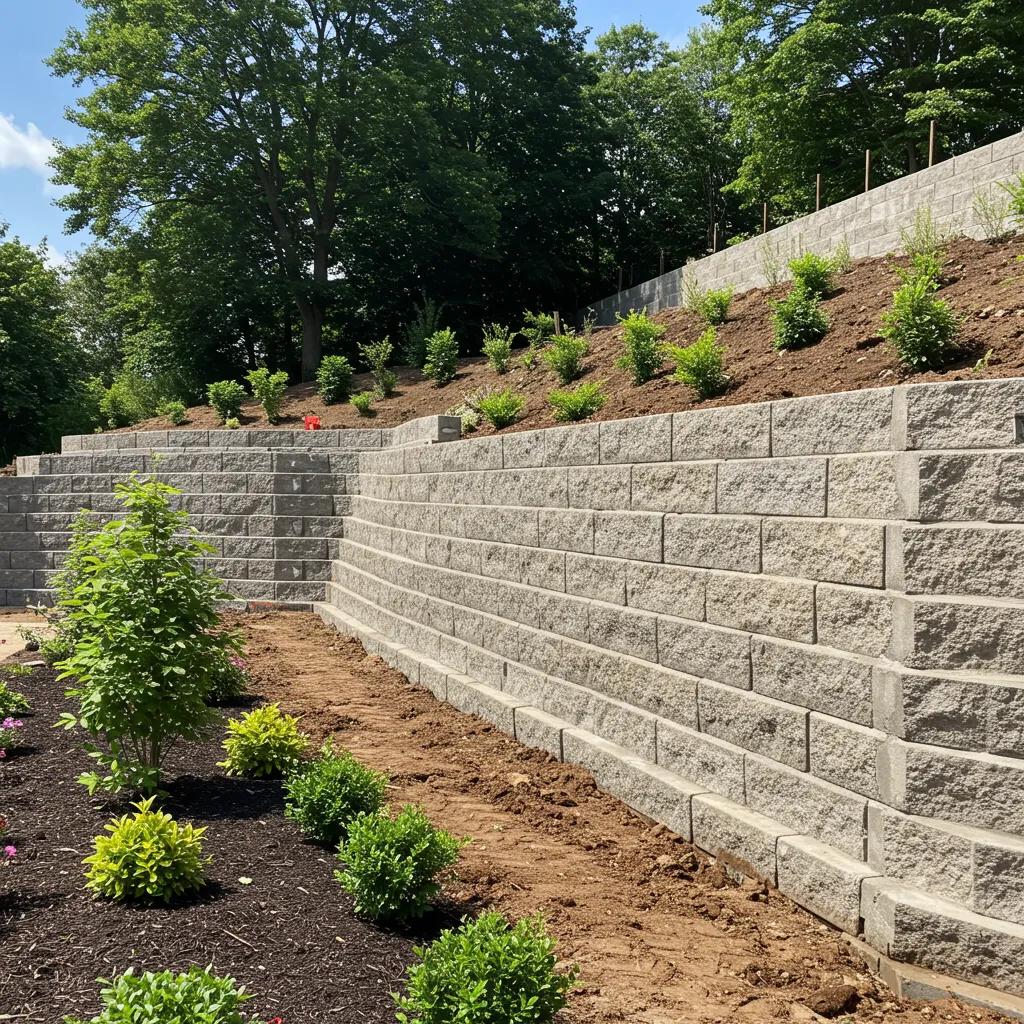
Reinforced Concrete Retaining Walls and Durable Retaining Wall Blocks: Building Strength and Stability That Lasts
Introduction
Reinforced concrete retaining walls and durable retaining wall blocks solve a fundamental engineering problem: holding back soil and managing slope stability while resisting hydrostatic pressure, erosion, and imposed loads. This guide explains how poured reinforced concrete and interlocking retaining wall blocks work, why reinforcement and drainage are essential, and when each solution is appropriate for garden wall retaining, basements, and heavy-duty civil projects. Readers will gain practical design principles, installation checklists, and maintenance schedules to extend service life, together with comparisons of structural concrete retaining wall design choices and retaining wall drainage solutions. The article maps the core topics that follow: definitions and comparisons of wall systems, the technical benefits of reinforced concrete and reinforcement types, how a contractor delivers robust solutions, commercial and residential applications, design and maintenance best practices, and cost and timeline drivers. Throughout, relevant terms such as geogrid reinforced retaining walls, concrete formwork specialists Surrey, and sustainable concrete retaining walls are integrated to support informed decisions.
What Are Reinforced Concrete Retaining Walls and Retaining Wall Blocks?
Reinforced concrete retaining walls are structural concrete elements strengthened with steel reinforcement to resist tensile stresses and bending produced by retained soil and surcharge loads; this combination delivers compressive resistance from concrete and tensile capacity from steel, producing a durable barrier that controls soil movement and hydrostatic pressure. Interlocking retaining wall blocks, by contrast, are modular manufactured units assembled dry or with mortar; they rely on geometry, mass, and sometimes geogrid reinforcement to form stable, often aesthetic, gravity or segmental walls. Understanding the material behavior, installation methods, and drainage needs of each approach helps select the correct wall type for garden, basement, or heavy-duty civil applications. Below we explain what reinforced concrete is, contrast block systems with poured concrete solutions, and list common UK wall types to guide selection and design.
What is reinforced concrete and why is it essential for retaining walls?
Reinforced concrete combines concrete‘s high compressive strength with steel reinforcement’s tensile capacity to manage bending and shear in retaining structures. This composite behavior is essential where walls are tall, loaded, or subject to uneven backfill pressures; reinforcement resists tensile stresses that plain concrete would crack under, and it enables cantilever and piled wall forms to remain slender yet strong. Reinforcement detailing—cover, bar spacing, and anchorage—affects durability and structural performance and must account for groundwater, chloride exposure, and design loads. Recognizing when reinforcement is required leads directly to appropriate formwork, ground beam, and foundation design in the construction sequence.
How do interlocking retaining wall blocks differ from poured concrete solutions?
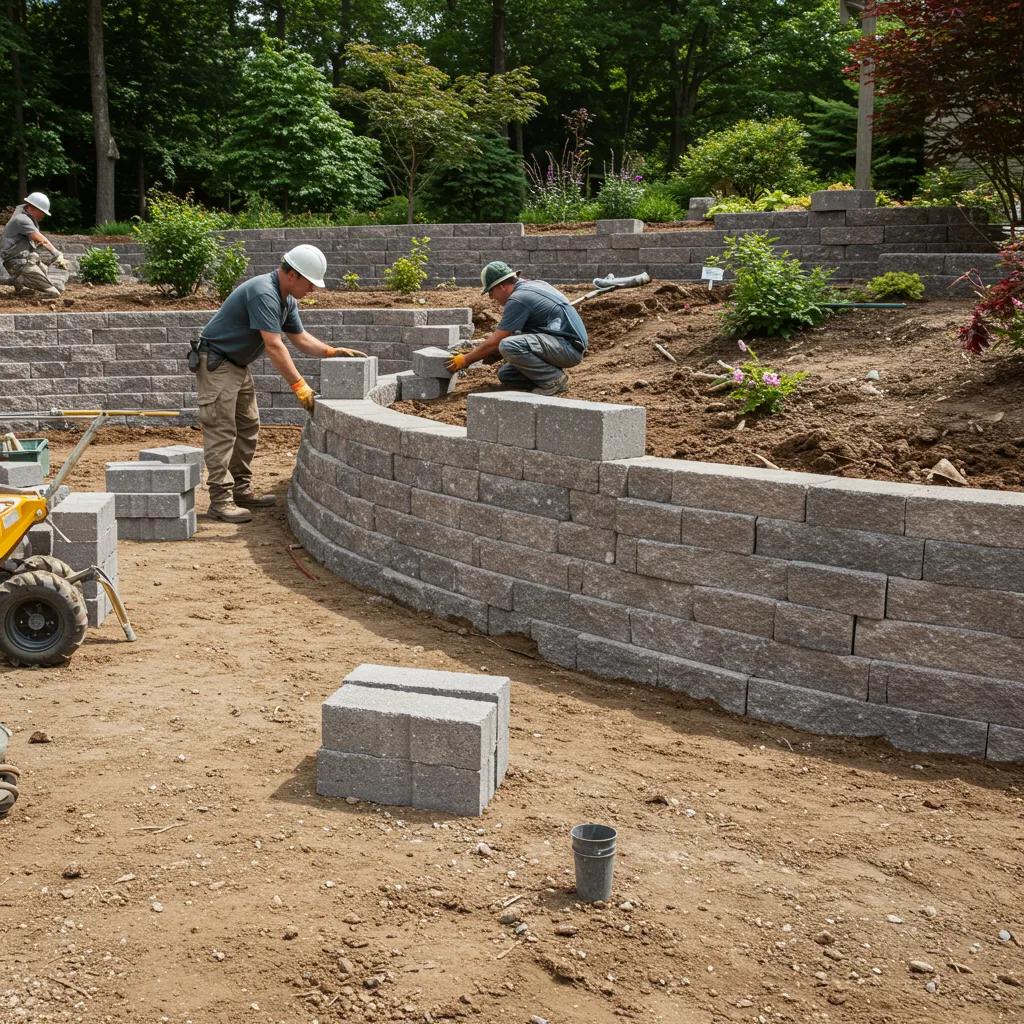
Interlocking blocks are modular units placed in courses and often use gravity, friction, or geogrid ties to retain soil; their strengths are ease of installation, aesthetic finishes, and suitability for lower walls or terracing in landscaping. Poured reinforced concrete provides monolithic strength, custom geometry, and high load capacity for basements, civil works, and heavy-duty retaining where blocks would be impractical or need extensive anchoring. Drainage requirements differ too: blocks generally need good granular backfill and vertical drainage channels, while poured walls integrate waterproofing and continuous subsoil drains as part of foundation detailing. Choosing between them balances typical costs, expected lifespan, and the scale of loads to be retained.
What types of retaining walls are commonly used in UK construction?
Common UK retaining wall types include gravity walls (massive sections relying on weight), cantilever reinforced concrete walls (slender stem on a base slab), anchored walls (with tendon anchors for high lateral loads), piled walls (suitable for deep excavations), and segmental interlocking block walls for landscaping. Each type suits different site conditions: gravity and block walls for low heights and garden uses, cantilever and piled walls for deep excavations and civil projects, and anchored solutions where space or ground conditions dictate. Selecting a type requires geotechnical input, consideration of hydrostatic pressures, and integration with drainage and waterproofing to ensure long-term stability.
| Wall System | Characteristic | Typical Application |
|---|---|---|
| Poured reinforced concrete | Monolithic strength, bespoke geometry, high load capacity | Basements, cantilever walls, commercial retaining |
| Interlocking concrete blocks | Modular, aesthetic, quicker install for small heights | Garden terraces, low garden retaining walls |
| Gravity walls (stone/concrete) | Large mass resists rotation | Landscaping where space permits and aesthetics matter |
This comparison highlights that poured reinforced concrete excels for heavy-duty, long-life solutions while interlocking block systems remain valuable for lower-height, aesthetic, or cost-sensitive landscape uses. Choosing the right system depends on loads, site access, and long-term maintenance expectations.
Why Choose Reinforced Concrete for Long-Lasting Retaining Wall Construction?
Reinforced concrete delivers long-term strength, high load-bearing capacity, and design flexibility, enabling solutions for high retaining demands and complex geometries; the material resists compressive loading while steel reinforcement carries tensile forces, resulting in durable structures that tolerate varying site loads and environmental conditions. Beyond raw strength, reinforced concrete offers predictable service life when detailed correctly, and it integrates readily with waterproofing, ground beams, and basement retention systems. The following list summarizes the principal benefits and connects them to practical outcomes for lifespan and risk reduction in garden wall retaining and civil projects.
- High structural capacity: Supports large earth pressures and surcharge loads for commercial and civil applications.
- Longevity: Properly detailed reinforced concrete can significantly outlast modular alternatives with lower lifecycle maintenance.
- Design adaptability: Allows bespoke shapes, integrated foundations, and seamless waterproofing for basements and complex sites.
- Resilience to fire and decay: Concrete resists biological decay and offers inherent fire resistance compared with timber options.
These advantages make reinforced concrete the preferred option where durability, minimal long-term maintenance, and structural certainty are priorities. For organizations or clients seeking end-to-end delivery of poured reinforced solutions at scale, B&R Steel Ltd has demonstrated capability in reinforced concrete, steel reinforcement, formwork, and groundworks, and can provide project quotes and surveys to match design requirements. The technical benefits described above lead naturally to a closer look at how steel reinforcement enhances performance and the role of drainage in extending wall life.
| Reinforcement Type | Role | Suitability |
|---|---|---|
| Rebar (deformed bars) | Resists tensile stresses and bending moments | Cantilever and piled walls |
| Reinforcement mesh | Controls crack widths and distributes loads | Slabs, ground beams, thin walls |
| Geogrid | Reinforces backfill and stabilizes soil mass | Segmental and geogrid-reinforced walls |
How does steel reinforcement enhance concrete retaining wall strength?
Steel reinforcement provides tensile capacity, ductility, and crack control that plain concrete lacks, enabling cantilever stems and slender foundations to resist bending and shear from lateral earth pressures. Rebar placed in tension zones and continuous mesh across slabs distribute loads, limit crack widths, and maintain structural integrity under variable loading such as traffic surcharge or surcharge from stored materials. Proper cover, concrete strength, and detailing prevent corrosion and ensure the composite action endures; design must reference relevant British Standards and geotechnical input. Understanding these detailing principles informs formwork sequence and quality assurance during placement to achieve the intended performance.
What are the key benefits of reinforced concrete retaining walls over other materials?
Reinforced concrete offers a predictable lifecycle, lower routine maintenance requirements, and adaptability to complex site constraints compared with timber, brick, or block alternatives, which may degrade, require more frequent repairs, or need anchors for taller applications. Quantitatively, poured reinforced concrete generally extends service life by decades under typical UK conditions when drainage and waterproofing are implemented correctly. This durability reduces whole-life costs despite higher initial outlay, making it economical for commercial groundworks contractors and developers. The comparison emphasizes that higher upfront investment in structural concrete often yields long-term savings and fewer interventions.
How does proper drainage impact retaining wall stability and lifespan?
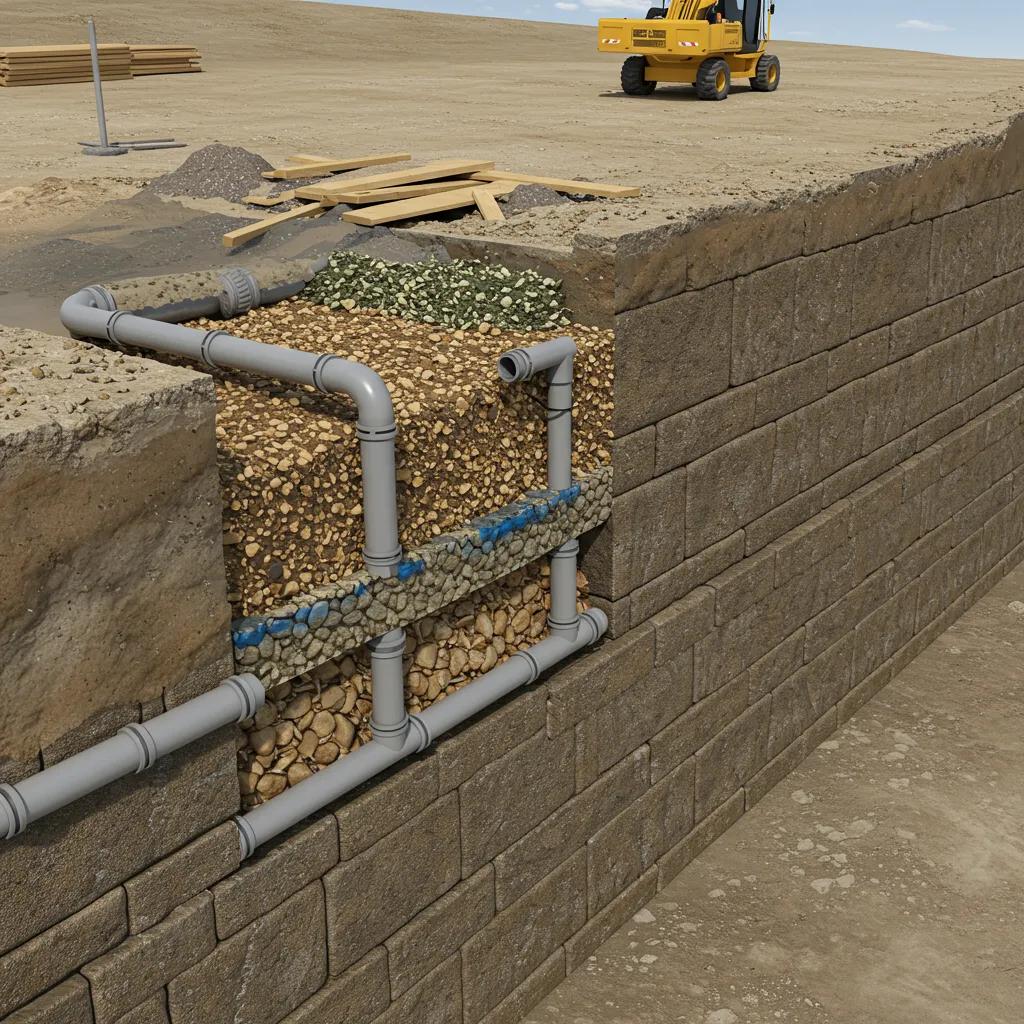
Effective drainage mitigates hydrostatic pressure behind the wall, preventing uplift, cracking, and overturning failures; common solutions include perforated subsoil pipes, granular backfill layers, and weep holes that relieve water build-up while preserving soil stability. Drainage design must consider pore water pressure, frost susceptibility, and maintenance access to avoid clogging over time, and it integrates directly with waterproofing in basement and deep retention systems. Poor drainage accelerates deterioration and can render even well-reinforced walls vulnerable, so a coordinated drainage and inspection regime is essential. Addressing drainage at design stage reduces long-term maintenance and supports predictable performance.
How Does B&R Steel Ltd Deliver Expert Retaining Wall and Reinforced Concrete Solutions?
B&R Steel Ltd offers integrated groundworks, formwork, steel reinforcement, and concreting services that produce robust reinforced concrete retaining walls and associated basement or civil structures, combining site preparation with reinforcement detailing and concrete placement to deliver a coordinated solution. The company’s workflow emphasizes staged groundworks, accurate formwork installations, and controlled concrete pours to meet structural design and durability objectives.
What groundworks and formwork services support durable retaining wall construction?
Essential groundworks include site clearance, accurate excavation to formation levels, sub-base preparation, and construction of foundations or ground beams in line with geotechnical recommendations; these tasks set the platform for durable retaining structures. Formwork selection—timber, engineered panel, or bespoke steel systems—controls concrete geometry and finish while supporting safe work sequencing and efficient concrete placing. Coordinated scheduling ensures formwork removal, reinforcement tying, and concrete curing align with structural requirements to avoid premature loading. Integrating groundworks, formwork, and reinforcement planning reduces rework and helps maintain programme reliability on constrained urban sites.
How does B&R Steel’s process ensure structural integrity and safety?
A structured process includes supervised reinforcement placement, concrete strength testing, cover verification, and on-site inspections to validate design assumptions and workmanship, which together safeguard structural integrity. Health and safety focus within site operations ensures safe access, sequencing, and handling of heavy reinforcement and formwork systems during installation. Coordination with design engineers, timely QA checks, and corrective actions where required prevent defects and align the delivered works with specification. These quality-driven steps reduce the risk of performance issues and support long-term durability by addressing critical execution points.
What sustainability practices does B&R Steel implement in retaining wall projects?
Sustainability measures include the use of recycled aggregates where suitable, material ordering strategies to minimize waste, and collaboration with suppliers that provide lower-embodied-carbon concrete options; these practices reduce environmental impact while maintaining structural standards. Efficient logistics and waste separation on site support recycling and minimize skips, contributing to measurable waste diversion from landfill. Client reporting on materials and waste outcomes can demonstrate sustainability credentials for developers seeking to manage embodied emissions. Implementing these strategies during groundworks and concreting aligns environmental considerations with robust construction delivery.
What Are the Commercial and Residential Applications of Reinforced Concrete Retaining Walls?
Reinforced concrete retaining walls serve a wide spectrum from heavy-duty commercial and infrastructure projects to residential garden walls and basement retention; their adaptability allows integration with structural frames, ground beams, and waterproofed basement linings. In commercial contexts, reinforced concrete interfaces with RC frames and specialist works such as staircases and bridges, handling high loads and complex coordination with main contractors. For homeowners, poured reinforced walls provide durable basement retention or discrete garden walls where long-term stability and low maintenance are priorities. The following list outlines typical applications across sectors and how design considerations differ.
- Infrastructure and commercial sites: High lateral loads, vehicle surcharge, and integration with civil frameworks.
- Residential basements and gardenwalls: Waterproofing, compact formwork, and aesthetic finishes for homeowner projects.
- Erosion control and landscaping: Terracing, stepped retaining, and integration with planting and drainage schemes.
How are reinforced concrete retaining walls used in commercial and civil projects?
In commercial and civil works, reinforced concrete retaining walls resist significant earth pressures, vehicle loads, and dynamic forces, requiring rigorous design coordination with structural engineers and main contractors to ensure foundations, ground beams, and adjacent works integrate correctly. Typical projects include highway embankment retention, commercial site excavations, and basement perimeter walls where waterproofing and tie-ins to frames are necessary. Construction sequencing often involves temporary works, piled foundations, and specialist traffic management in urban environments. Robust QA and testing regimes ensure that the delivered wall meets structural and regulatory requirements for long-term service.
What solutions are available for residential retaining walls and basements?
Homeowners can choose between interlocking block systems for low-height garden retaining, or poured reinforced concrete for basements and taller walls that demand waterproofing and long-term durability; selection depends on height, soil conditions, and budget. Residential poured walls integrate with basement waterproofing systems and ground beams to create habitable lower-ground spaces, while block systems suit terraces and landscaping. Specialist contractors assist with design approvals and ensure that drainage, access, and neighbor considerations are addressed. When in doubt, professional input prevents common pitfalls such as inadequate drainage or insufficient foundations.
How do retaining walls contribute to erosion control and landscaping design?
Retaining walls control erosion by stabilizing slopes, directing surface runoff through planned drainage, and allowing terracing that reduces runoff velocity and soil loss; they also create usable level areas for planting and hard landscaping. Design must account for planting zones, root growth, and maintenance access so that vegetation contributes to slope stability without damaging wall elements. Integrating drainage with planting plans ensures water is managed without saturating backfill, and combining aesthetic finishes with engineered detailing provides both functional and visual outcomes. Properly designed walls thus deliver erosion control and durable landscaping solutions.
How to Ensure a Successful Retaining Wall Project: Design, Installation, and Maintenance?
A successful retaining wall project follows a clear sequence: site and geotechnical assessment, structural design and reinforcement detailing, proper foundation and formwork execution, controlled concreting and curing, and an inspection-led maintenance plan; each step reduces risk from instability, drainage failure, or premature deterioration. Below is a practical checklist that guides owners and contractors through essential phases and supports consistent delivery across garden wall retaining, basements, and civil applications.
- Site and geotechnical survey: Obtain soil data and groundwater conditions to inform foundation and drainage design.
- Design and detailing: Confirm reinforcement, cover, waterproofing, and interface with adjacent structures.
- Groundworks and formwork: Prepare formation, install suitable formwork, and ensure reinforcement is correctly placed.
- Drainage and waterproofing: Install subsoil drains, granular backfill, and membrane protection where needed.
- QA and maintenance plan: Test concrete strength, inspect for cracks, and schedule drainage inspections.
This step-by-step approach creates transparency and reduces surprises during delivery, and it emphasizes decisions that materially extend service life. Implementing these steps with experienced contractors ensures design intent translates into durable in-ground results.
What are the essential design principles for reinforced concrete retaining walls?
Essential principles include checks for overturning and sliding, adequate foundation bearing capacity, correct reinforcement to resist bending and shear, and drainage measures to control hydrostatic forces; these principles ensure stability under expected loads and environmental conditions. Design must follow relevant standards and incorporate geotechnical input for soil parameters and groundwater behavior, which inform factor-of-safety choices and foundation sizing. Attention to cover, concrete specification, and detailing around construction joints influences durability, particularly where chloride exposure or freeze-thaw are considerations. Clear coordination between design and construction teams ensures principles are implemented in the field.
Why is professional installation critical for retaining wall durability?
Professional installation enforces correct sequencing, quality of formwork, and accurate reinforcement placement; failure in any of these areas commonly leads to cracking, inadequate drainage, or foundation settlement that shortens service life. Contractors apply controlled concrete placing and curing regimes, test concrete strength, and complete site QA checks that detect issues before they become defects. Professional teams also manage site logistics, temporary works, and interface with other trades to reduce rework and programme delays. Investing in expertise therefore reduces whole-life costs by preventing recurring maintenance and structural remediation.
How long do reinforced concrete retaining walls typically last with proper care?
With correct design, drainage, quality materials, and routine inspections, reinforced concrete retaining walls commonly provide multiple decades of service and in many cases significantly longer, depending on exposure and maintenance; conservative estimates assume lifespans measured in decades rather than years. Factors that influence longevity include durability of reinforcement cover, effectiveness of drainage systems, exposure to aggressive agents, and the quality of concrete mix and curing. Regular inspections to clear drains, monitor cracks, and control vegetation will preserve performance, and timely remedial actions extend life further. Planning maintenance intervals and documenting performance supports predictable, long-term outcomes.
What Are the Key Factors Affecting Retaining Wall Costs and Project Timelines?
Material selection, site access, ground conditions, and the required level of reinforcement and drainage drive costs and influence programme duration; each factor can multiply labour and plant requirements or introduce specialist tasks such as piling or dewatering. Below is a breakdown of typical cost drivers and their effect on budget and schedule, together with planning tips owners can apply to reduce uncertainty and speed delivery.
- Material choice: Concrete strength, reinforcement quantity, and waterproofing increase upfront costs but often reduce lifecycle expenditure.
- Site conditions and access: Restricted urban access, deep excavations, or rock excavation increase plant costs and time on site.
- Groundworks complexity: Contamination removal, piling, or dewatering extend programmes and require specialist subcontractors.
| Cost Element | Effect on Cost/Time | Typical Impact |
|---|---|---|
| Materials (concrete, rebar) | Increases material cost and handling time | Medium–High |
| Labour and specialist trades | Scheduling complexity, higher hourly cost for specialists | High |
| Site conditions (rock, contamination) | May require extra works (piling, remediation) | High |
| Access and logistics | Need for cranes, traffic management, off-site prefabrication | Medium |
How do material choices influence the cost of retaining wall construction?
Material choices determine both initial outlay and lifecycle expenses: poured reinforced concrete has higher initial cost but typically lower maintenance, while block and timber solutions may be cheaper initially but need more repairs or replacement. Concrete mix design, reinforcement grade, and waterproofing options alter unit costs, and specialists may recommend recycled aggregates or optimized mixes to balance cost with sustainability. Considering whole-life costs rather than headline price helps align choices with long-term value. Early cost modelling that includes maintenance scenarios clarifies the economic trade-offs.
What role do groundworks and site conditions play in project duration?
Groundworks and site conditions such as groundwater, rock strata, or contamination dictate excavation methods, the need for temporary works, and potential specialist remediation, all of which extend programme durations. Restricted access in urban London and Surrey sites often requires staged deliveries, smaller plant, or off-site prefabrication to maintain progress, while clear site surveys reduce surprises. Phased scheduling, contingency planning, and early geotechnical reporting enable contractors to mitigate delays. Prioritizing these investigations at tender stage shortens delivery risk and supports reliable timelines.
How can clients plan for efficient project delivery with B&R Steel Ltd?
Clients can support efficient delivery by providing timely design approvals, ensuring site access, and coordinating services, while engaging contractors early for groundworks sequencing and procurement planning. B&R Steel Ltd coordinates groundworks, formwork, reinforcement, and concreting activities and communicates scheduling expectations to minimize downtime and manage interfaces with other trades across London and Surrey projects. Requesting a site assessment and sharing geotechnical reports upfront enables accurate estimates and realistic programmes. Open communication and early contractor involvement reduce risk and create a clear path to on-time completion; clients may request a quote or site survey to begin planning.
What Are Common FAQs About Reinforced Concrete Retaining Walls and Retaining Wall Blocks?
This FAQ section offers concise answers to high-value questions commonly searched by homeowners and professionals, providing quick guidance that supports decisions about materials, installation, and maintenance. Each reply focuses on practical, actionable knowledge to capture featured snippet-style responses and direct readers to deeper sections above for technical detail.
What is the strongest material for retaining walls?
For heavy-duty, high-load applications, reinforced concrete is the strongest material due to its combined compressive strength and steel-provided tensile capacity; it is preferred where high lateral loads, long-term durability, and integration with basements or structural frames are required. Other materials such as stone or reinforced block can be strong for lower-height or aesthetic uses but generally lack the adaptability and guaranteed load capacity of poured reinforced concrete. Material selection should follow design loads, site conditions, and lifecycle cost analysis. Consulting structural design guidance ensures the chosen material meets required safety and performance margins.
How do you build a strong and durable retaining wall?
Building a durable retaining wall requires a clear sequence: accurate geotechnical assessment, robust foundation design, correct reinforcement and cover, effective drainage, and quality-controlled concrete placing and curing; each step mitigates failure modes such as sliding, overturning, or saturation-induced collapse. Proper formwork, testing of concrete strength, and inspection of reinforcement placement ensure that design intent is realized in the finished structure. Post-construction, scheduled inspections of drainage and crack monitoring preserve performance. Following these steps reduces long-term maintenance and improves predictability of service life.
Should I hire a professional contractor for retaining wall installation?
Yes—professional contractors provide design coordination, quality control, correct sequencing, and compliance with standards, which are essential for walls above certain heights, basements, or where site constraints amplify risk; DIY may be acceptable only for low garden walls under local regulations and with appropriate drainage measures. Professionals also manage specialist tasks such as piling, dewatering, and integration with waterproofing systems, and they provide documentation that supports warranties and future maintenance. Engaging a contractor early reduces unforeseen costs and improves safety. For site-specific advice and a formal estimate, a site survey is recommended.
What maintenance is required to prolong retaining wall life?
Routine maintenance includes clearing and inspecting subsoil drains, checking and repairing any cracks, controlling vegetation close to the wall, and monitoring for signs of settlement or movement; these actions prevent water build-up and structural deterioration. Inspection intervals of at least annual visual checks, plus immediate attention after heavy storms, help catch issues early before they escalate. If professional intervention is needed, contractors can remediate drainage, underpinning, or concrete repairs to restore performance. For clients seeking assistance or a site survey, B&R Steel Ltd provides groundworks, formwork, and reinforced concrete capabilities and can advise on maintenance strategies and remedial options by phone.
This final FAQ guidance equips owners with rapid, pragmatic answers and routes to professional support where needed, closing the loop between technical specification and real-world application.